
How to Cope and Live with Chronic Illness: Reflections from Our Caregiver's Conversation
Watch the full Caregiver's Conversation
This Caregiver's Conversation explores how to cope with and live with chronic illness, with a focus on mental health, mindset, and community support.
To help you get the most out of this conversation, we’ve included a reading guide below with key reflections and simple practices you can use as you watch or return to later.
Caregiver’s Conversation Reading Guide: Coping and living with chronic illness
This guide is designed to support you as you watch this Caregiver's Conversation.
You can pause, reflect, or return to sections later. There is no right way to use it. Take what feels helpful.
You may hear something that feels familiar, or something you have not put into words before. Both matter.
1. Noticing your thoughts
One of the key ideas from this conversation is simple:
What we practice, we become.
Take a moment to notice:
What thoughts have been repeating for you lately?
Are they helping you, or adding more weight?
You do not need to change them right away. Just noticing is a first step.
2. Limiting beliefs and liberating truths
This is a practice you can try while watching or afterward.
Write down one thought that feels heavy or discouraging.
Example:
“I will never feel like myself again.”
Then write a response to it.
Example:
“I am learning new ways to care for myself.”
You do not have to fully believe the second statement. Even a small shift matters.
3. Coming back to the present
Many people shared that the hardest moments come from thinking too far ahead.
If you feel yourself spiraling, try:
Naming a few things around you
Focusing on one object
Taking a slower breath
You do not need to fix everything. Just come back to where you are.
4. Finding what works for you
There is no single way to cope with this disease.
Some people use:
Breathing or grounding exercises
Movement or stretching
Music or distraction
Writing things down
Talking with someone they trust
You may need to try a few things. What works can change over time.
5. Mind and body are connected
Stress, fear, and uncertainty can show up in the body.
Slowing down, even briefly, can help signal safety.
This does not take everything away, but it can make things more manageable.
6. Community matters
A strong message from this conversation:
You are not alone.
There will be days when you need support.
There will also be days when you can support someone else.
Both are part of this experience.
7. Holding two truths
Living with chronic illness is hard.
At the same time, many people find:
A deeper understanding of themselves
Stronger relationships
A different sense of what matters
Both of these things can exist together.
Reflection
If you want to pause and reflect:
What felt most familiar to me in this conversation?
What felt new or different?
Is there one small thing I can try this week?
A simple practice
If you take one thing from this guide:
Notice one thought
Write it down
Respond to it
Take a few slow breaths
That is enough.
Final thought
Some days will feel heavier than others.
You do not need to have everything figured out.
We are here to walk through this together.

Why Mental Health Belongs in Rare Disease Care
Mental health is often treated as separate from physical health. For individuals living with IgG4-related disease, that separation does not reflect reality.
The rare disease journey can include:
Long diagnostic timelines
Misdiagnoses and uncertainty
Medical procedures and hospitalizations
Ongoing vigilance and fear of flares
Over time, these experiences can take an emotional toll that deserves recognition and support.


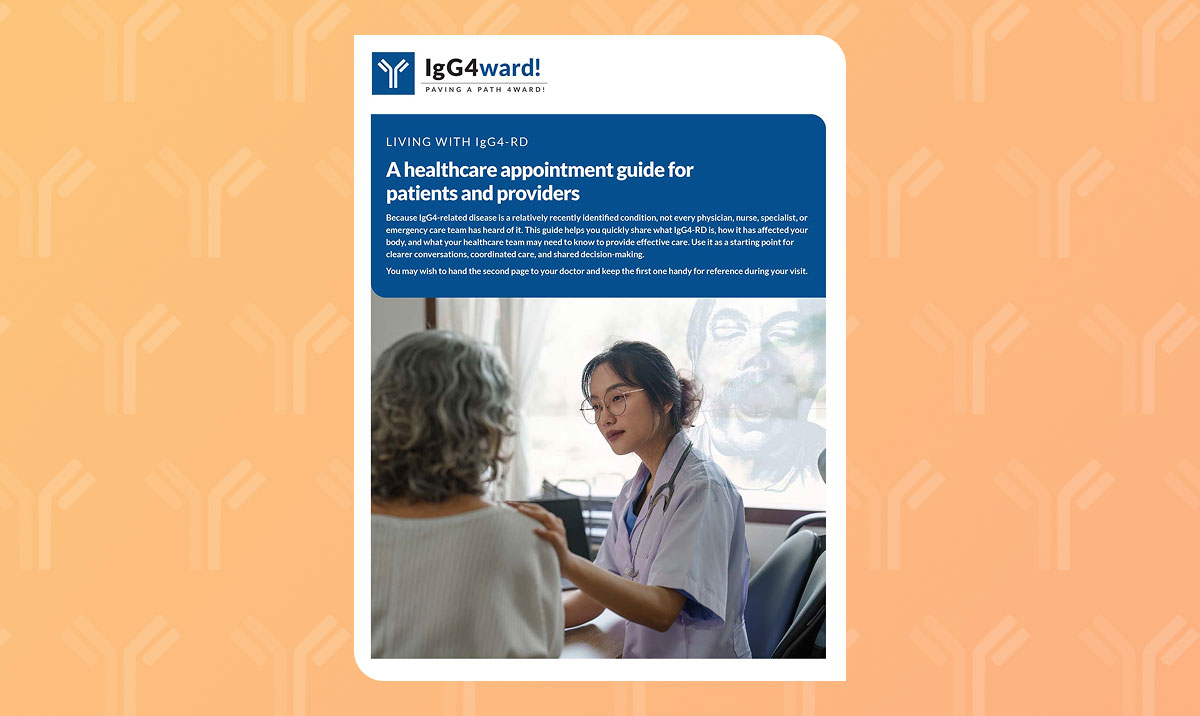
A healthcare appointment guide for patients and providers
A guide to help you quickly share what IgG4-RD is, how it has affected your body, and what your healthcare team may need to know to provide effective care.
Read more
What to expect at IgG4ward! CamJAM: October 11 in Cambridge
Learn what to expect at IgG4ward! CamJAM on October 11, 2026, in Cambridge, Massachusetts: IgG4-RD education, expert Q&A, and connection for patients and caregivers.
Read more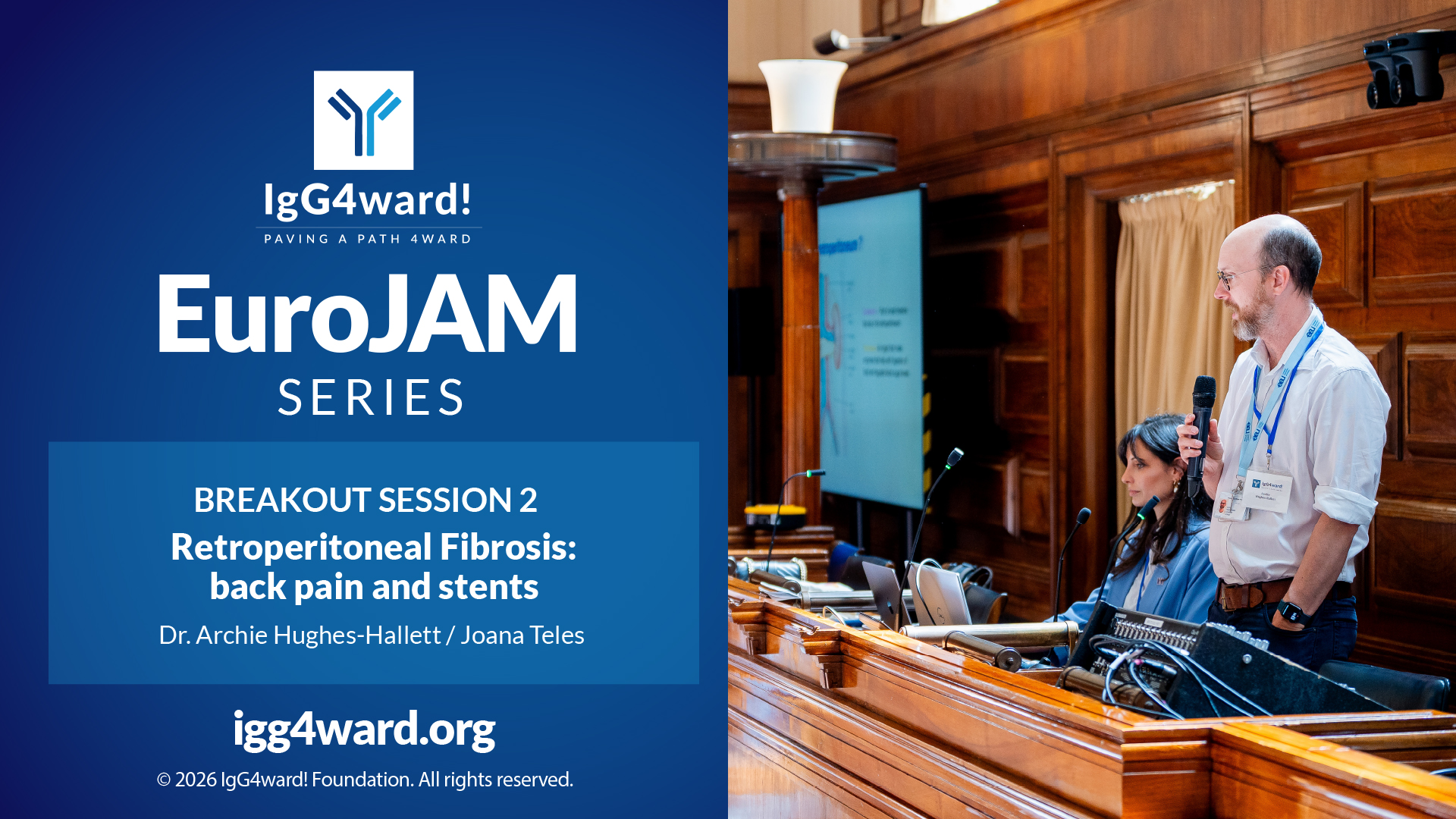
IgG4ward! EuroJAM Session 6: Retroperitoneal fibrosis, back pain, stents, and kidney health
Learn how retroperitoneal fibrosis can affect people living with IgG4-related disease. Dr. Archie Hughes-Hallett and Joanna Teles, a Kidney Nurse Specialist, explain back and abdominal pain, urinary obstruction, hydronephrosis, ureteric stents, nephrostomy tubes, surgical considerations, and kidney health.
Read more
IgG4ward! EuroJAM: Hope in action
Hope was a theme throughout the IgG4ward! EuroJAM - but not as wishful thinking. Patients, caregivers, researchers, physicians and industry partners came together to share knowledge, build connections and move the conversation around IgG4-related disease forward. Here's a look back at the event and what's coming next.
Read more