IgG4-RD Question of the Week – IgG4-RD, the salivary glands, other potential organ involvement, and insurance coverage
QUESTION: I was diagnosed with IgG4 disease in 2016 with the surgical removal of a salivary gland. I seem to have the RS version of IgG4, and I haven’t been able to find much information on this version. Is there anything I should look for as far as other organ involvement? I was on regular Rituximab infusions and got my IgG4 levels down to 50. This year my health insurance company has decided to stop paying for my infusions, so I am going to start taking Methotrexate. Hoping this keeps my symptoms (lethargy & sinus congestion) at bay.
RESPONSE: Thank you for your question. It is highly relevant to many people living with IgG4-RD and also has multiple other implications, so I’ve constructed a fairly detailed answer.
Your question calls to mind the very first patient I ever recognized to have IgG4-RD: a 26-year-old woman from Casablanca, Morocco (then living in Boston) who was referred because it was thought that she might have Sjögren’s syndrome, another condition that can involve the major salivary glands.
But before proceeding, let’s take a step back to explain clearly. In writing about the “RS” version of IgG4-RD, you are referring to IgG4-related sialoadenitis. Sialoadenitis is the medical term for inflammation of the major salivary glands: the glands around the oral cavity (mouth) that produce saliva. When we speak of the major salivary glands, we usually refer to three: the submandibular gland, the parotid gland, and the sublingual gland. Both submandibular and parotid enlargements are illustrated in the Figure..
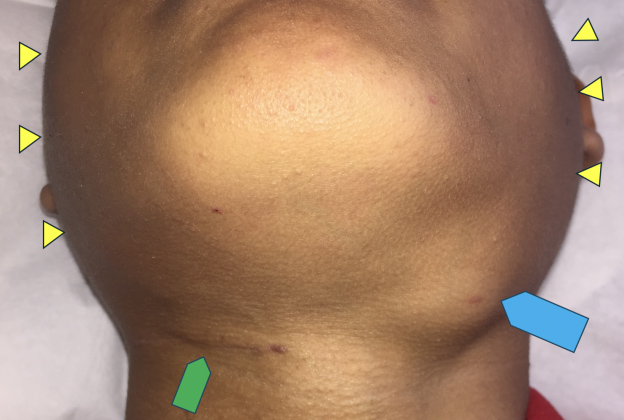
Figure. A young man with IgG4-RD who has had involvement of his major salivary glands (as well as involvement of his lungs, kidneys, pancreas, and lymph nodes). The yellow arrowheads outline the large parotid glands on both sides of his face. The blue arrow shows the enlarged left submandibular gland. The green arrow points to the surgical scar from the procedure for the right submandibular gland removal, which was performed for diagnostic purposes
Here is a clinical pearl: When the submandibular gland is involved in isolation or well out of proportion to the other major salivary glands, the diagnosis is almost always IgG4-RD. Sjögren’s syndrome, for example, does not cause submandibular gland enlargement that is out of proportion to enlargement of the other glands. (Sjögren’s is more likely to affect the parotid gland prominently, but not the submandibular glands. IgG4-RD can affect all three, but often particularly involves the submandibular gland).
With regard to the second part of your question – “Is there anything I should look for as far as other organ involvement?” – the answer is “Yes, absolutely”.
When a patient appears to have IgG4-RD involving the major salivary glands, it is important not to stop the search there. IgG4-RD has the potential to be (and most often is) a multi-organ disease. It is important to search for the possibility of disease in other organs. To do this, we usually employ imaging: namely, computed tomographic (CT) scans. At the time when IgG4-RD affecting the major salivary glands is diagnosed, we usually perform CT scans of the chest, abdomen, and pelvis to screen for disease in other organs. It is not unusual to find that a patient who appears to have only involvement of the submandibular glands, for example, actually has IgG4-RD affecting the pancreas, bile ducts, kidneys, or lungs.
Imaging tests other than CT scans are also acceptable, depending on the clinical circumstances, and it is sometimes appropriate to use imaging studies periodically in the course of following patients over time.
Finally, you note that you have been on B cell depletion treatment with rituximab, that your serum IgG4 concentration has decreased to 50 mg/dL now (normal in most labs is < 86 mg/dL), and that the addition of methotrexate has been contemplated because your insurance will no longer pay for rituximab.
Here are some additional thoughts about that:
Your disease may be under such good control now that you may need only careful monitoring and not ongoing, active treatment. It is possible that you could take a “drug holiday” and monitor your disease carefully with blood tests every 3-4 months for a while. (Let me know if you have additional questions about that.)
If you decide with your doctor that continued treatment is appropriate now given your own clinical situation, methotrexate might be a reasonable approach. It is not candy, however. It has potential side effects and requires regular blood test monitoring, as well as the use of a vitamin (folate) that is found in most multivitamin preparations.
The idea that your insurance company has decided that it won’t pay for rituximab anymore, even if you need it, is regrettable. Better access to medications for IgG4-RD is one of the major parts of the mission of the IgG4ward! Foundation.
Better access requires several steps including:
Scientific understanding of what makes IgG4-RD tick (what are the important immunological mechanisms of the disease)
Development of new treatment strategies designed to target these mechanisms
Collaboration of investigators across the world to study the new treatment strategy in clinical trials. (This frequently involves partnerships with industry)
Proving that the new treatment works in well-designed, randomized, double-blind, placebo-controlled trials
Discussions with regulatory agencies such as the U.S. Food & Drug Administration (USFDA) and the European Medicines Agency (EMA) about why the new treatment is better than the existing standard of care
Work to ensure patients can get the new treatment once it is approved. This involves discussions with payers (i.e., your insurance company and others: the third parties that make decisions about whether or not an approved therapy will be paid for).
So, there are a lot of steps in the process. But I’m pleased to say that with IgG4-RD we are now nearly finished with the first such cycle for the first drug studied in a worldwide, randomized clinical trial in IgG4-RD: inebilizumab. The full results of this trial will likely be presented this fall around the time of the IgG4ward! JAM in November – at the American College of Rheumatology. The results may also be published in a major medical journal around that same time. Moreover, the IgG4-RD community is also well down this path now with another medication – obexelimab – which is being studied in another major phase 3 trial.
The final step in the process of ensuring that patients have appropriate access to the treatment – discussions with payers – involves collaboration with organizations such as the Alliance for Patient Access (AfPA). Representatives from the AfPA – Mr. Ryan Crump and Mr. Casey McPherson - will be attending the IgG4ward! JAM in November, so we will have the opportunity to interact with them personally and help drive an important agenda for people living with IgG4-RD.
Thank you for your question.
Stay up to date with the question of the week and the latest happenings within the IgG4-RD community by joining the IgG4ward! Online Community.