IgG4ward! Good Question Series: Organs Affected by IgG4-RD
Good Question:
"I was recently diagnosed with IgG4-RD following a kidney biopsy... After the biopsy results were back, my doctor noticed that I also have swelling of the submandibular glands and a CT scan of my abdomen showed that I have inflammation in my pancreas that I was not aware of, either.
My questions are these:
Which organs are the ones most commonly affected by IgG4-RD, and how common is it to have more than one organ affected?"
- Donald, IgG4ward! Community Member
Answer:
We thank Donald for this recent question to the IgG4ward! Foundation.
Characteristics of IgG4-related disease (IgG4-RD)
IgG4-RD has several characteristic disease features:
It is slow moving. A person diagnosed with IgG4-RD has typically had inflammation in one or more organs for months or even years.
It remains subclinical for long periods of time. This means the disease is quietly active inside the body, possibly causing damage or inflammation, but without showing clear signs that would make someone immediately realize there is a problem.
It frequently involves multiple organs. In the recent MITIGATE trial of Inebilizumab in IgG4-RD, the inclusion criteria required that patients have a history of at least two organs affected.
How Many Organs Can Be Affected?
Organ involvement In the MITIGATE trial:
The number of organs affected over the course of the disease ranged from 2 to 13 (!).
41% had histories of 2-3 organs involved
24% had 6 or more organs affected
It is important to realize that some types of organ involvement can be asymptomatic at times when disease in other organs is obvious. This means the disease may be affecting certain organs without causing any noticeable symptoms.
For example, orbital involvement may be clear because a patient's eye appears swollen. However, kidney inflammation can only be detected through laboratory tests and imaging studies.
Visual Data on Organ Involvement
The figure below shows the number of organs affected in patients in the MITIGATE trial, either before or at the time of trial entry.
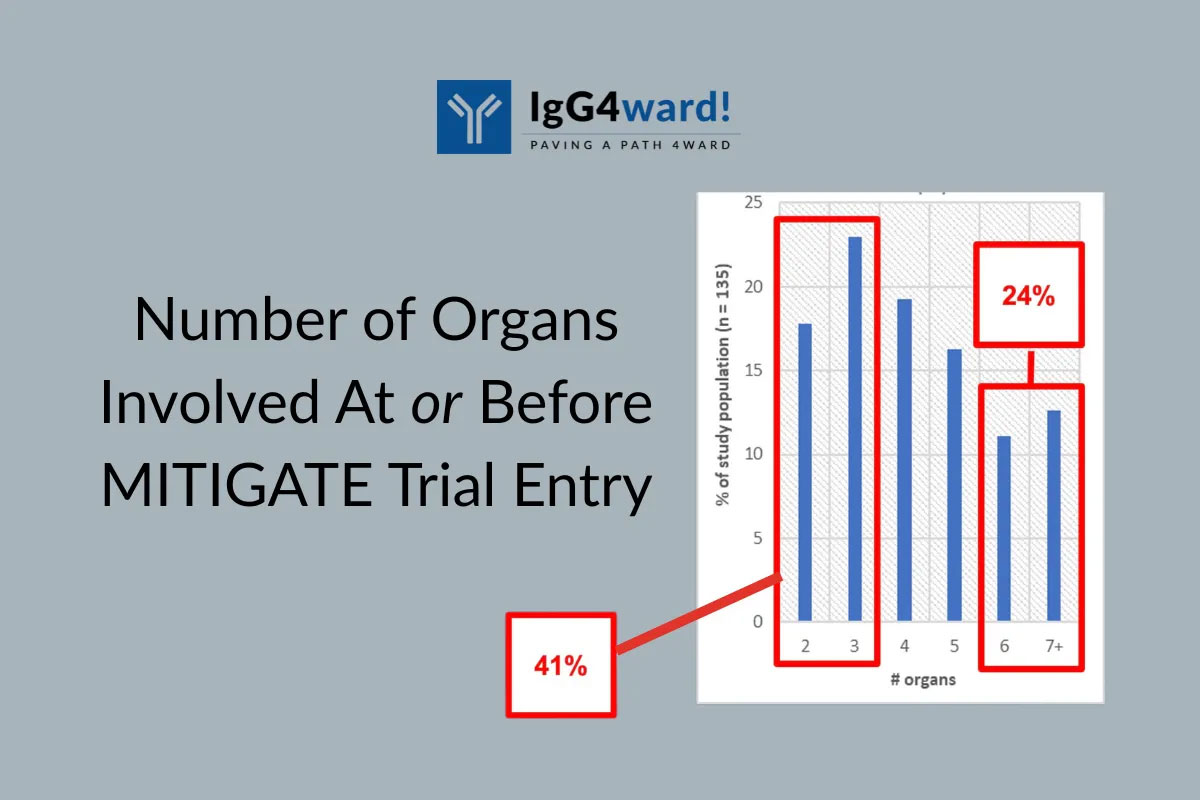
Table: Which Organs Are Most Commonly Affected?
The following table lists the specific organs affected among patients in the MITIGATE trial, either at the time of enrollment or earlier in their disease history.
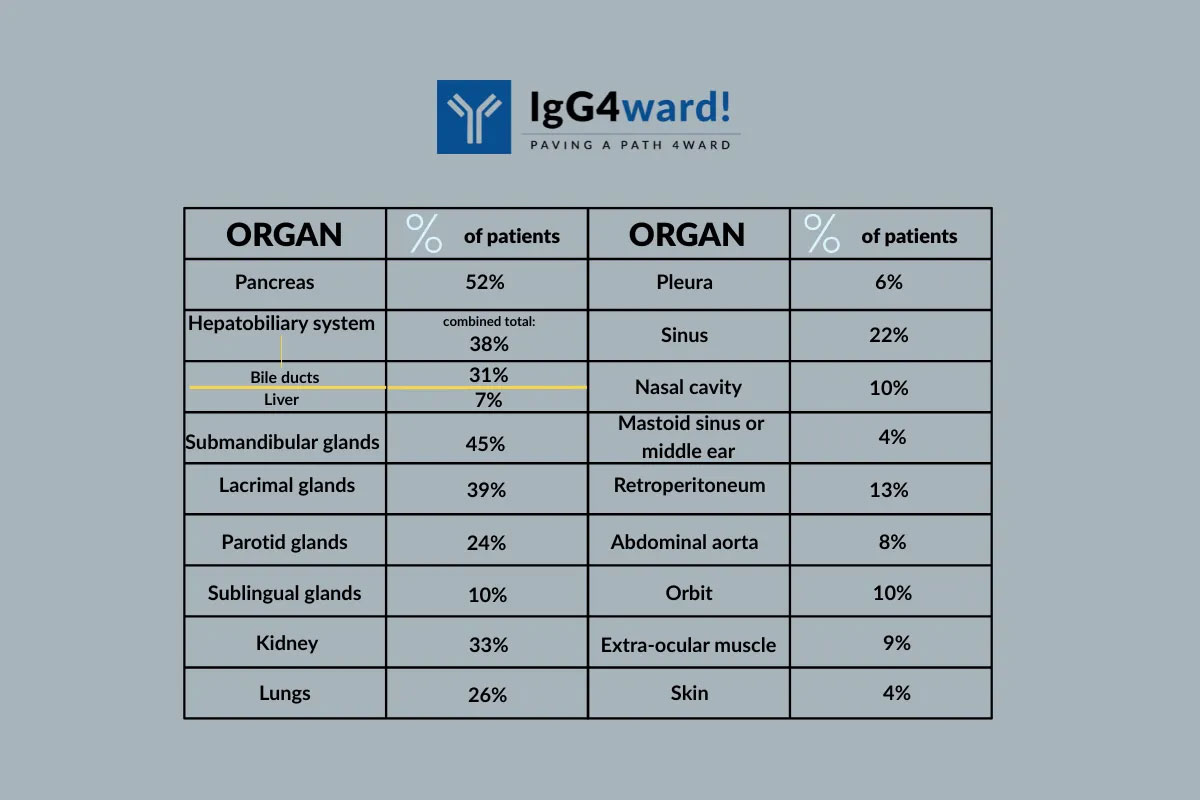
Thus, the major salivary glands (submandibular, parotid, sublingual) and the pancreas are the most commonly involved organs. That said, the range of organs affected in IgG4-RD is remarkably broad.
In fact, the MITIGATE data may underestimate the frequency of some organ involvement.
For example, retroperitoneal fibrosis likely occurs in 25-30% of patients. Yet, patients with only that complication were less likely to be enrolled in MITIGATE because trial criteria required at least two organs to be affected.
What This Means for Patients
This knowledge about the disease has several important implications:
First, the slow-moving nature of IgG4-RD means it doesn't cause damage quickly. That is obviously a plus!
Second, the fact that it can be quietly active allows it time to cause permanent organ damage if not identified and treated.
Third, it is important to take a comprehensive survey of organs that might be affected. This is usually done via routine blood tests and CT scans of the chest, abdomen and pelvis at the time of diagnosis.
Finally, imaging may need to be repeated at varying intervals if there is concern about disease activity. These decisions are made case by case, based on clinical findings and lab tests.

Want to Learn More?
To explore more about how IgG4-related disease impacts the body, please check out the following resources:
MITIGATE Trial in NEJM - Read the landmark clinical study in the New England Journal of Medicine.
Education and Resources from the IgG4ward! Foundation - Access patient-friendly information, videos and downloadable guides to help you understand IgG4-RD and its impact on organs like the pancreas, kidneys, lungs and more.
Thank you to our sponsor for supporting patient education through our Good Question Series: