Question of the Week: “Should I continue on prednisone or should I switch to another treatment – for example, B cell depletion?”
“I was diagnosed with IgG4-RD seven years ago, with multiple organs affected. I have been keeping it under control with a daily dose of 5 mg of prednisone. Should I continue on prednisone, or should I switch to another treatment – for example, B cell depletion? I am 74 years of age.”
We thank this IgG4-RD community member for this question of the week and can make some general statements that apply to many IgG4-RD patients in similar situations. We avoid providing direct medical advice when it comes to the management of individual cases, however, because we do not have access to all of the aspects and nuances of the specific situation.
Having said that, let’s begin:
Steroids (for example, a medication known as prednisone) are currently the standard of care across the world for IgG4-RD. Steroids are generally very effective in controlling IgG4-RD if given in sufficient quantities. Treatment with steroids can lead to clinical remissions (that is, the absence of any signs of active disease). Unfortunately, steroids typically provide only temporary disease control. It is common for disease flares – that is, the return of objective signs of active disease – to occur once steroids are discontinued or tapered to low doses.
Some patients are able to maintain disease remissions for variable periods of time after steroids are stopped and others – as in the case of this questioner – maintain their disease remissions by remaining on some dose of steroid. The amount of steroid required to maintain a disease remission in these circumstances varies according to the individual patient.
Deciding whether or not to remain on steroids always involves a discussion between a patient and her or his personal physician.
This discussion includes consideration of the balance between the potential benefits of continuing steroid treatment and the potential side effects that steroids can cause. Dr. Arezou Khosroshahi from Emory University in Atlanta, an IgG4ward! Board Member, gave a talk at the Fifth International Symposium on IgG4-RD (April 2024, Milan) entitled
“Is there a time to stop immunosuppressive therapy in patients with IgG4-related disease?”
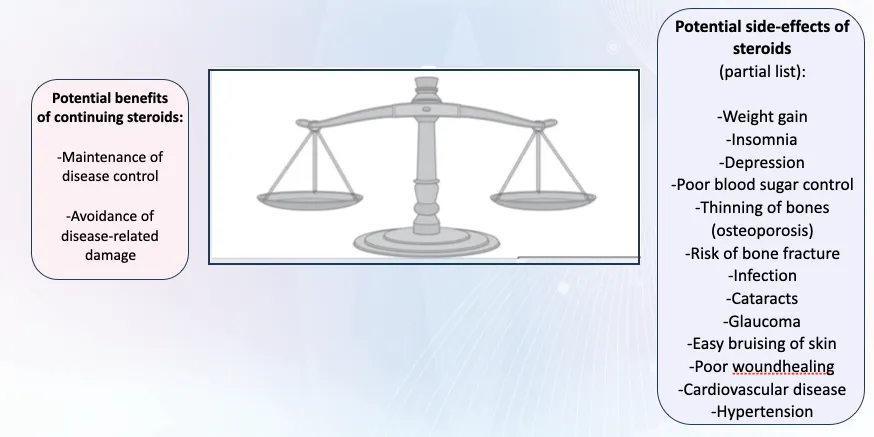
In that talk, she addressed the questions of “if and when” to stop steroids. The figure below is modified from her talk:
Figure. Balancing the potential benefits and risks of side effects of ongoing steroid use.
Steroids are powerful because affect essentially every cell in the body: not only those cells of the immune system that have become overactive and are contributing inflammation and organ damage, but also cells that are “innocent bystanders” – those that are performing their normal functions. The widespread effects of steroids – good and bad – stem from the fact that the steroid receptor (the mechanism by which the drugs get into cells) is found on a remarkably high percentage of cells in the human body. Therefore, steroids can affect, for good and bad, a wide variety of our normal processes and functioning.
Steroid use, even in low doses, can be associated with a long list of side effects, a partial list of which is shown in the Figure. Many of these side effects can be serious. For example, even only 5 milligrams of prednisone per day has been shown to be associated with a substantially increased risk of infections leading to hospitalization, and there is no dose of prednisone that is safe for a patients’ bones: all doses increase the risk of osteoporosis (thin bones).
Some of the effects of steroids occur quickly. Others are silent at first and take longer to become evident. As examples, patients who have recently begun a course of prednisone may note immediately adverse impacts on their sleeping, mood, mental status, blood sugar control, and blood pressure. On the other hand, one of the features of steroids that make them so potentially dangerous is that many of their effects are insidious. The person taking steroids may not note any effects of these medications on their eyes, bones, or the protective elements of the immune system – until complications such as glaucoma, hip fracture, and serious infection emerge.
There are several helpful and hopeful points to consider:
Awareness of the potential for side effects of steroids can lead to measures that help prevent or improve some of them.
The use of other medications with steroids can lead to lower steroid requirements, potentially decreasing steroid toxicity. These other medications include both “biologic” agents such as B cell depletion treatments and conventional treatments such as mycophenolate mofetil or leflunomide.
Finally, the IgG4ward! Foundation is actively creating ways that people living with IgG4-RD who are on steroids can educate themselves further about the risks of steroids, optimize the use of steroids when these drugs are necessary, and participate in research about ways to help reduce steroid toxicity. There is more to come on these efforts soon.
For patients on long-term treatment with steroids, it is almost always worth re-visiting certain questions every once in a while. These are shown below:
Questions To Ask If You Are Taking Steroids To Treat Your IgG4-RD
Are the steroids still necessary?
Would a lower dose be appropriate?
Are there certain supportive measures and preventive actions that might decrease the risk of steroid toxicity?
Is there another medication that might improve the chances that steroids can be discontinued safely?
There will be much more discussion of these questions in the months and years to come as the Foundation helps the IgG4-RD community move toward the day when more effective and safer treatments are available and widely approved for use.
At the moment, there is no other medication that has been approved for use by regulatory authorities such as the U.S. Food & Drug Administration, the European Medicines Agency, or the Japanese Pharmaceuticals and Medical Devices Agency.