When the Body Speaks: How My Childhood Illness Shaped My Work in Advocacy
Long before I became a clinical social worker, long before I was a caregiver, and long before I held the title Director of Advocacy, I was a child whose body was trying to say something no one yet understood.
This story isn’t just about my childhood. It’s about how uncertainty, prolonged diagnostic journeys, and the need to be believed shape lives, and how those experiences inform the advocacy work I do today at the IgG4ward! Foundation. As the work of the IgG4ward! Foundation continues to grow and deepen, I wanted to take a moment to share the experiences that shape how I approach advocacy, community, and support, and why those values matter so much to me.
A Childhood Marked by Illness & Uncertainty
I was eight years old when I became chronically ill. I looked pale, felt weak, and lived with an exhaustion no child should know. Some days, I wasn’t just tired. I was too weak and sick to move off the couch. I missed years of school, stopped playing soccer, and spent more time in doctors’ offices than on playgrounds.
At that age, I didn’t understand diagnoses or lab results. What I understood was the unknown. I didn’t know why my body wouldn’t cooperate or when it might feel better again. What I didn’t fully understand then but can see clearly now is how serious my situation appeared to the adults around me. My bloodwork was consistently abnormal. My white blood cell counts were very low, and no one could explain why. That single finding set off an intense search for answers.
Test after test followed. I had blood drawn constantly, sometimes multiple times a week. We visited doctors and laboratories so often that it became routine. When answers didn’t come, we were referred onward to specialists, to an infectious disease doctor, and to larger, well-known hospitals where teams of clinicians reviewed my case and searched for explanations.
Looking back, I can see how much effort, expertise, and concern went into trying to understand what was happening inside my body. At the time, all I felt was the tedious repetition, the waiting – and the uncertainty.
The Weight Carried by Parents & the Power of Being Seen
My parents carried the weight of what was being considered quietly. They knew that the most frightening possibilities were being ruled out, even as answers remained elusive. They protected me from that fear while continuing, tirelessly, to advocate for more testing, more opinions, and more possibilities.
What mattered just as much as the testing was the pediatrician who never gave up. He was observant and patient, and he listened to both me and my parents. He could see that I was sick, even when the answers weren’t clear yet. Every appointment felt calm in his presence.
He always had a small koala bear wrapped around his stethoscope. It was something I focused on while he listened to my heart and lungs. That koala became an anchor for me, a reminder that I was safe and being cared for. It taught me something I still carry with me: that being calm, present, and observant can matter just as much as having answers.
Long before I had words for it, I was learning what it felt like to be truly seen in a medical setting.
Care, Adaptation & Quiet Acts of Advocacy
Life became measured in energy: what I could do, and what I simply couldn’t do. What stuck with me most from that time wasn’t all of the appointments and tests. Rather, it was the quiet, human ways the people who loved me responded when answers weren’t available.
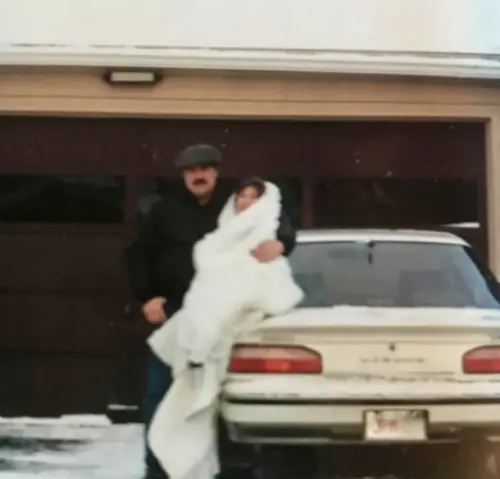
On days I was too weak to go outside, my father wrapped me in blankets and carried me outdoors. He believed fresh air mattered, even if I couldn’t yet feel it. Sometimes he built snow forts in the yard and told me they’d be ready “when I felt up to it.” On Sundays, no matter how I felt, he took me on long drives to feed my grandfather’s pigeons. Music played softly as the road stretched ahead. Without knowing it, he was teaching me a coping skill I still rely on today. Movement, music, and presence can calm both the body and the mind, and I call upon those often, even now.
My mother turned our kitchen into a place of possibility. Bottles of echinacea, vitamin C, and ginseng lined the counter. Every morning, she stirred supplements into orange juice with a spoon, not because she was sure it would work, but because caring meant trying. She showed me, long before I had words for it, that advocacy can look like persistence, hope, and showing up again and again.
Even my childhood friendships adjusted around my limits. My best friend adapted our playdates without ever making it feel like a loss, offering quieter games, shorter visits, and long stretches of simply being together. She never made me feel like a burden. She just made room.
Living With a Diagnosis & What Remains After
Eventually, I was diagnosed with myalgic encephalomyelitis/chronic fatigue syndrome (ME/CFS), a complex and often misunderstood condition marked by profound exhaustion and limited energy that does not improve with rest. It offered some explanation, but it didn’t erase the years of uncertainty that came before it. What those years left me with was something I wouldn’t fully understand until much later: an instinct to listen carefully when someone says, “I don’t feel right.”
That instinct followed me into adulthood.
How Lived Experience Shaped My Path Into Advocacy
It guided me into social work, where I spent nearly twenty years in an inner-city school listening to children whose struggles were often unseen, stemming from anxiety, trauma, grief, and pain that didn’t fit neatly into categories. I learned that healing often begins not with answers, but with attention and belief in the experience someone is having.
Later, it guided me again when I became a caregiver to my husband, who lives with IgG4-related disease, during his long and complex diagnostic journey. Once more, I found myself living alongside uncertainty. I learned how exhausting it can be to wait for clarity, and how important it is to feel supported while doing so.
Advocacy as Presence, Belief & Support
Today, as Director of Advocacy for the IgG4ward! Foundation, I bring all of those experiences with me, as something that actively informs how I show up in this work every day. I bring my clinical training and professional expertise, of course. But I also bring the lived memory of what it feels like to exist inside the unknown, when a body is struggling, and answers are still out of reach. I know what it means to live with a condition that isn’t always visible and is often misunderstood, where symptoms don’t neatly announce themselves and credibility can feel fragile.
I also understand that receiving a diagnosis doesn’t mark the end of the journey. On the contrary, it marks a new beginning. There is suddenly the new work of learning how to live with a chronic condition, of navigating ongoing care, uncertainty, and adaptation, and of making sense of what life looks like going forward.
For me, advocacy means creating space for people to be heard, believed, and supported, especially when answers are incomplete. This perspective shapes how I approach advocacy in my work with the IgG4ward! Foundation. It reminds me that people don’t just need information or eventual diagnoses. They also need to feel believed, supported, and accompanied throughout the entire journey, including long after a name has finally been given to what their body has been carrying.
Advocacy, to me, isn’t about having all the answers.
It’s about standing beside someone while the answers are still being found.
It’s about making room, the way my pediatrician did, the way my parents did, the way my friend did, when a body is asking to be understood.
And it’s about making sure that when the body speaks, someone is truly listening.
Author
Katharine Provencher is the Director of Advocacy and Community Engagement at the IgG4ward! Foundation.