
A healthcare appointment guide for patients and providers
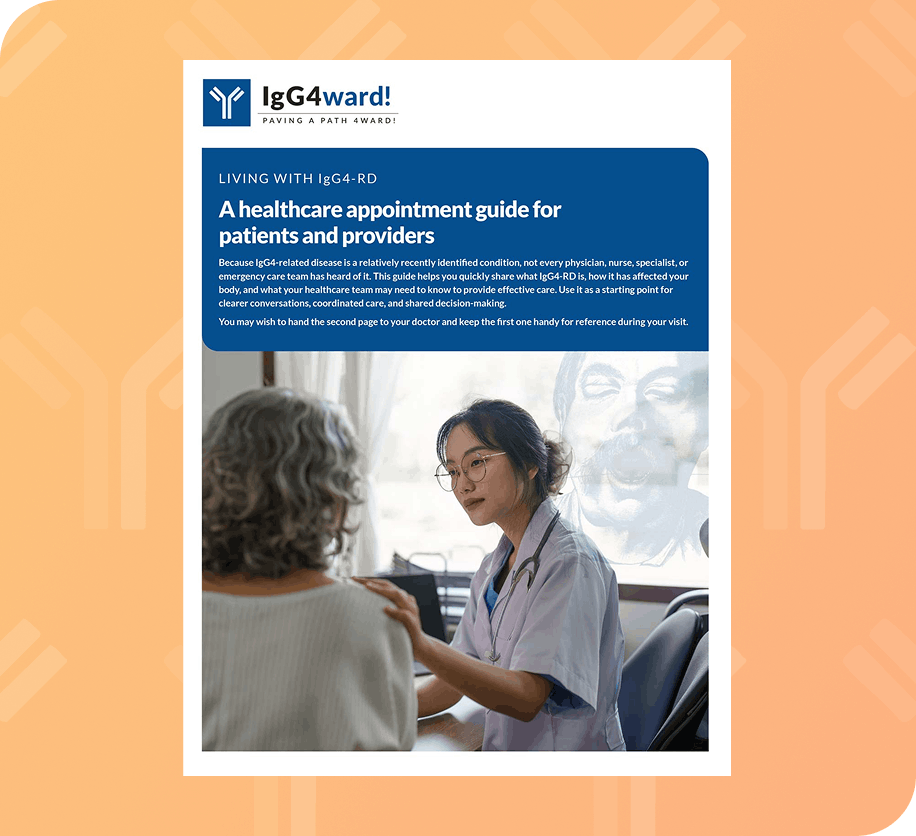
A guide to help you quickly share what IgG4-RD is, how it has affected your body, and what your healthcare team may need to know to provide effective care.
What's included
Because IgG4-related disease is a relatively recently identified condition, not every physician, nurse, specialist, or emergency care team has heard of it. This guide helps you quickly share what IgG4-RD is, how it has affected your body, and what your healthcare team may need to know to provide effective care. Use it as a starting point for clearer conversations, coordinated care, and shared decision-making.
You may wish to hand the first two pages to your doctor then fill out and keep handy the remaining pages for reference during your visit.
Share this guide:

What caregivers and healthcare providers need to know about IgG4-RD
I have been diagnosed with IgG4-related disease, also called IgG4-RD. IgG4-RD is a systemic immune-mediated disease that can cause inflammation, organ enlargement, and fibrosis in one or more parts of the body. It may present with mass-like lesions that mimic cancer or dysfunction of the affected organs leading to much diagnostic confusion until the full diagnostic picture is reviewed.
IgG4-RD is considered a rare disease and can involve nearly any organ system. Common sites include:
the pancreatobiliary system (“autoimmune pancreatitis” and “IgG4-related sclerosing pancreatitis,” which resembles primary sclerosing cholangitis);
the major salivary glands (parotid, submandibular) and the lacrimal glands;
the orbits (extra-ocular muscles);
the retroperitoneum (retroperitoneal fibrosis);
as well as the lungs, kidneys, aorta and medium-to-large vessels, lymph nodes, and other tissues.
Care often involves coordination across rheumatology, gastroenterology, and other specialists, including nephrology and urology, depending on the specific organs involved.
There is no single test that confirms the diagnosis of IgG4-RD in every patient. Diagnosis usually depends on the pattern of symptoms, imaging, blood tests, biopsy findings when available, and careful exclusion of diseases that can mimic it. A normal or mildly elevated serum IgG4 level does not necessarily rule IgG4-RD in or out.
Please consider my known IgG4-RD history when evaluating new symptoms, but also please evaluate urgent symptoms on their own merits. People with IgG4-RD can still have infections, blood clots, heart problems, acute kidney injury, medication side effects, cancer, or other emergencies. They also often have glucose intolerance because of pancreatic involvement by the disease.
Please also be sure to consult my IgG4-RD treating physician before making changes to my IgG4-RD treatment, initiating corticosteroids for another condition, or attributing symptoms to medication side effects.
Important clinical considerations
Because IgG4-RD is rare and can resemble other conditions, a broad differential is often helpful. Please keep in mind:
A tumor-like lesion may need evaluation for both IgG4-RD and malignancy.
New symptoms may be related to IgG4-RD, treatment effects, or could be an unrelated acute condition.
A serum IgG4 measurement can be useful in context (particularly in comparison to historical values, if available), but a high or low serum IgG4 does not confirm or exclude IgG4-RD on its own.
Before starting or stopping steroids or immune-directed therapy, it may be helpful to consider infection risk, biopsy timing, and input from my treating specialist when feasible.
Vaccines may need timing around corticosteroids or immune-directed therapies; coordinate with my treating specialist when feasible.
Helpful questions a doctor might ask an IgG4-RD patient
About my diagnosis & disease pattern
How was IgG4-RD diagnosed?
Which organs have been affected?
Which organs are active now?
Was there a biopsy? Which organ was biopsied?
Were IgG4 staining or other special pathology tests done?
Were cancer, infection, lymphoma, or other mimics ruled out?
What did your first flare look like?
How does today compare with your usual IgG4-RD symptoms?
About my treatment history
Which treatments have you used?
When was your last infusion or steroid course?
What helped?
What caused side effects or complications?
About procedures and complications
Have you had a biliary stent, ureteral stent, nephrostomy tube, port, biopsy, or surgery?
Have you had bile duct blockage, kidney blockage, pancreatitis, lung disease, eye/orbital disease, vascular involvement, or fibrosis?
Do you have standing laboratory orders with your IgG4-RD physician?
How often do you undergo imaging to monitor disease activity?
About follow-up
Who coordinates you IgG4-RD care?
Who should be contacted before changing treatment?
Access the full guide and checklist
Including your checklist for your next appointment.
References
1. Stone JH, Zen Y, Deshpande V. IgG4-related disease. New England Journal of Medicine. 2012;366:539–551.
2. Peyronel F, Della-Torre E, Maritati F, et al. IgG4-related disease and other fibro-inflammatory conditions. Nature Reviews Rheumatology. 2025;21:275–290.
3. Arias-Intriago M, Gomolin T, Jaramillo F, et al. IgG4-related disease: Current and future insights into pathological diagnosis. International Journal of Molecular Sciences. 2025;26:5325.



A healthcare appointment guide for patients and providers
A guide to help you quickly share what IgG4-RD is, how it has affected your body, and what your healthcare team may need to know to provide effective care.
Read more
What to expect at IgG4ward! CamJAM: October 11 in Cambridge
Learn what to expect at IgG4ward! CamJAM on October 11, 2026, in Cambridge, Massachusetts: IgG4-RD education, expert Q&A, and connection for patients and caregivers.
Read more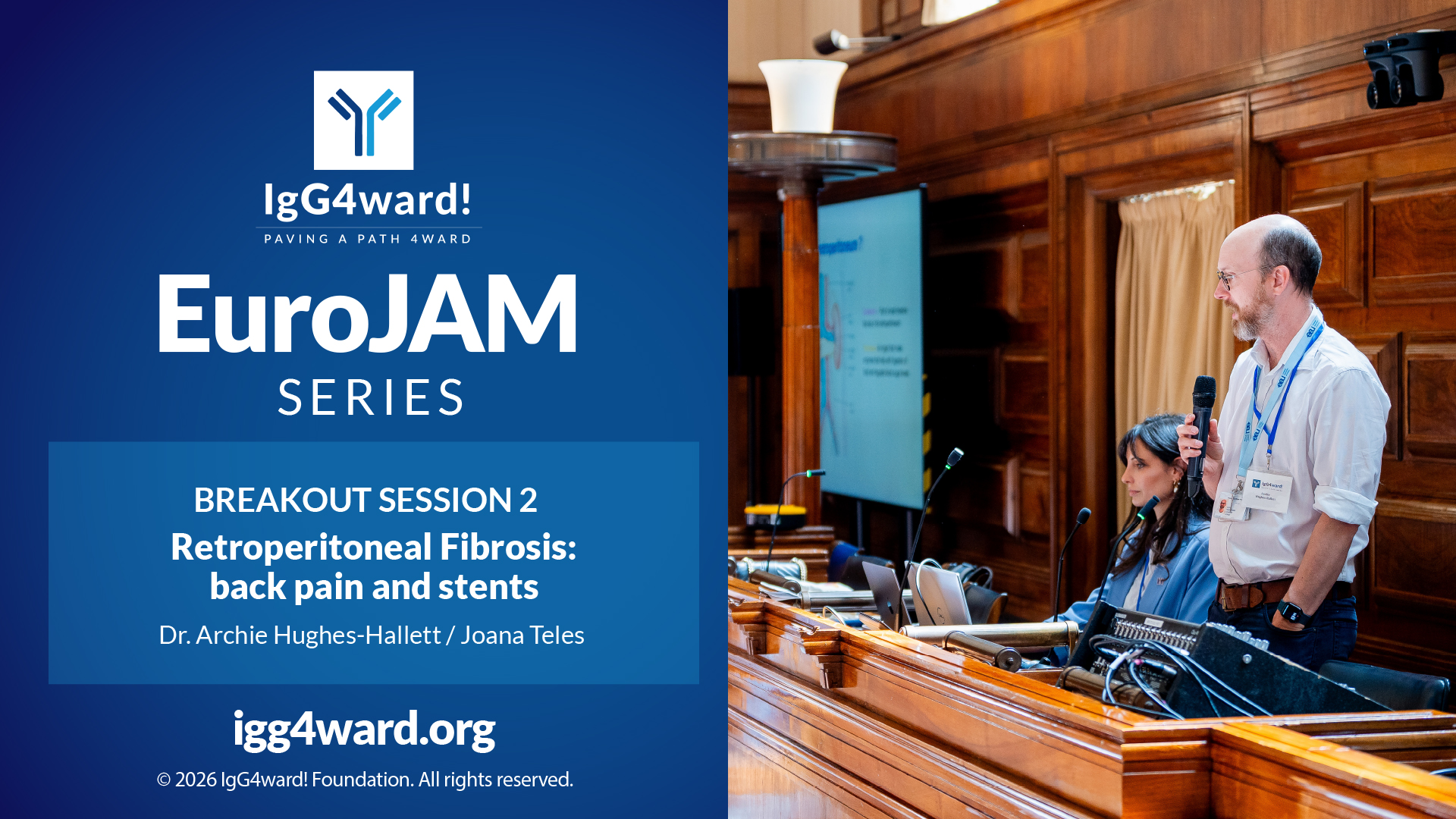
IgG4ward! EuroJAM Session 6: Retroperitoneal fibrosis, back pain, stents, and kidney health
Learn how retroperitoneal fibrosis can affect people living with IgG4-related disease. Dr. Archie Hughes-Hallett and Joanna Teles, a Kidney Nurse Specialist, explain back and abdominal pain, urinary obstruction, hydronephrosis, ureteric stents, nephrostomy tubes, surgical considerations, and kidney health.
Read more
IgG4ward! EuroJAM: Hope in action
Hope was a theme throughout the IgG4ward! EuroJAM - but not as wishful thinking. Patients, caregivers, researchers, physicians and industry partners came together to share knowledge, build connections and move the conversation around IgG4-related disease forward. Here's a look back at the event and what's coming next.
Read more