
IgG4ward! EuroJAM Session 5: Understanding Medications and Managing Side Effects in IgG4-related disease
Learn about medications used to treat IgG4-related disease through an interactive discussion with Dr. Maria Leandro and Comfort Dawodu. This educational resource explores why medications are used, common steroid side effects, infection risk, vaccinations, mood and sleep changes, bone and muscle health, and the importance of ongoing treatment monitoring.

Medications play an important role in treating IgG4-related disease (IgG4-RD). Understanding why they are used, what potential side effects to look for, and when to speak with your healthcare team can help patients and caregivers feel more informed throughout treatment.
In Session 5 of the IgG4ward! EuroJAM Educational Series, Dr. Maria Leandro, Consultant Rheumatologist at University College London Hospitals, and Comfort Dawodu, Advanced Clinical Practitioner at Oxford University Hospitals NHS Foundation Trust, lead an interactive discussion about medications used to treat IgG4-RD.
The speakers introduce steroids, disease-modifying antirheumatic drugs (DMARDs), and other medications that affect the immune system. The session then focuses particularly on steroids, including common short- and long-term side effects and practical considerations for people taking them.
Audience questions and shared experiences are woven throughout the session, creating a patient-centered discussion about treatment, everyday life, and communication with the healthcare team.
Watch the session:
Key Takeaways from the IgG4ward! EuroJAM Session 5
Explore the questions below for key information discussed by Dr. Maria Leandro, Comfort Dawodu, and members of the EuroJAM community during this interactive session.
Medications may be used to reduce inflammation, control disease activity, maintain remission, and help protect organs and tissues from damage caused by IgG4-RD.
During the session, the speakers explain that different medications can play different roles in managing the disease. Steroids can be particularly useful when inflammation needs to be brought under control quickly.
DMARD stands for Disease-Modifying Antirheumatic Drug.
During the session, Dr. Leandro explains that these medicines are different from medications such as painkillers that primarily treat symptoms. DMARDs affect the immune system over time to help suppress inflammation and reduce the risk of damage.
The terms immunosuppressant and immunomodulator may also be used for medications that suppress or modify immune-system activity.
Steroids can work quickly to reduce inflammation.
During the session, steroids are described as a “fire extinguisher” that can help bring inflammation under control quickly while further testing takes place and longer-term treatment is considered.
Steroids can be very effective, but they can also cause side effects, particularly when used at higher doses or for longer periods.
The speakers discuss a range of possible short- and long-term effects, including:
Changes in blood sugar
Indigestion and stomach irritation
Increased infection risk
Mood changes and irritability
Changes in energy and sleep
Swelling and fluid retention
Increased appetite and weight changes
Bone thinning
Skin thinning and easy bruising
Eye problems
Muscle weakness
Not everyone will experience the same effects. The speakers encourage patients to pay attention to new or changing symptoms and discuss concerns with their healthcare team.
Steroids and other medications that suppress the immune system can make it harder for the body to deal with some infections.
The speakers discuss practical steps such as good hand hygiene, being mindful around people who are clearly unwell, and taking additional precautions when appropriate.
They also encourage patients taking immunosuppressive medications to seek medical advice when they feel unwell or develop possible signs of infection rather than simply waiting for symptoms to resolve.
Vaccinations are an important part of the audience discussion.
The speakers explain that people taking steroids or other medications that suppress the immune system may not develop the same response to a vaccine as someone who is not immunosuppressed. However, a reduced response does not necessarily mean that no protection develops.
The session also explains that live vaccines may not be appropriate while taking certain immune-suppressing medications.
Individual situations can differ, and the speakers encourage patients to discuss vaccination questions with their healthcare team and, when needed, specialists with expertise in infection, immunity, or allergy.
Yes. The session discusses changes in mood, energy, irritability, anxiety, and sleep while taking steroids.
Family members and friends may sometimes notice these changes before the person taking the medication recognizes them.
The speakers encourage patients to make the people around them aware of possible side effects and to speak with their healthcare team when changes in mood or sleep are having a meaningful effect on everyday life or relationships.
Steroids can increase appetite and can also affect the body in ways that influence weight, fluid retention, and how fat is distributed.
The speakers emphasize that steroid-related body changes are not simply about what someone eats. Even someone who is careful about food may experience physical changes because of the effects steroids have on the body.
Balanced, regular meals and healthy food choices are discussed as ways to help manage some effects. The session also recognizes that weight and body changes can have a significant psychological impact and encourages patients to discuss concerns with their healthcare team.
Longer-term or higher-dose steroid treatment can contribute to bone thinning and muscle weakness.
The speakers discuss bone-density scans, calcium and vitamin D when prescribed, weight-bearing movement, physiotherapy, walking, swimming, and other forms of activity that can be adapted to an individual’s abilities.
Muscle weakness may make everyday activities such as climbing stairs, getting up from a chair, or carrying things more difficult.
The session emphasizes continuing to move within your own abilities and asking for support when needed.
The discussion recognizes that exercise can be difficult when someone is already experiencing fatigue or muscle weakness.
The speakers and audience discuss gradually building activity, adapting the type of exercise, walking with another person, swimming, chair-based movement, and getting physiotherapy support when available.
An audience member also shares an important practical lesson: do a bit, rest a bit, and avoid trying to do too much at once.
Regular blood tests and other monitoring can provide information about how well the disease is controlled and whether treatment may be causing harm.
A key message from the speakers is that monitoring is part of treatment, not simply an added exercise.
Monitoring is particularly important when starting a medication but continues to be important during treatment.
The speakers also encourage patients to be open with their healthcare team if they are having difficulty taking a medication so that concerns can be discussed.
The speakers specifically warn against suddenly stopping steroid treatment.
Steroid doses may need to be gradually reduced, a process known as tapering.
Patients should speak with their healthcare professional before stopping or changing their steroid treatment.
Helpful terms from this session:
DMARD (Disease-Modifying Antirheumatic Drug):
A name used for medications that modify the disease process. During the session, Dr. Leandro explains that these medicines affect the immune system over time to help suppress inflammation and reduce the risk of damage.
Immunomodulator:
A medication that changes or modifies how the immune system works.
Immunosuppressant:
A medication that suppresses, or reduces, activity in the immune system.
Opportunistic infection:
An infection that may cause illness when the immune system has been suppressed even though it might not normally cause problems in someone whose immune system is working normally.
Steroids:
Medications that can quickly reduce inflammation and immune-system activity.
DEXA scan:
A bone-density scan used to check for bone thinning.
Tapering:
Gradually reducing the dose of a medication rather than stopping it suddenly.
Medication monitoring:
Regular checks, including blood tests, that help the healthcare team understand how well treatment is controlling the disease and whether the medication may be causing harm.
Moments from the EuroJAM Session 5:








IgG4ward! EuroJAM Session Series
This presentation marks the fifth release in the IgG4ward! EuroJAM educational series.
Over the coming weeks and months, the IgG4ward! Foundation will continue releasing additional educational sessions from this landmark international gathering.
We invite you to follow along as we bring the conversations, insights, and educational content from IgG4ward! EuroJAM to the broader IgG4-RD community.
Subscribe to our YouTube channel and follow the Foundation for future session releases.
Medical Disclaimer - Educational Purposed Only
The information provided on this page and in the accompanying EuroJAM session is intended for educational and informational purposes only and is not intended to serve as medical advice, diagnosis, or treatment.
This content reflects key themes discussed during Dr. Maria Leandro and Comfort Dawodu’s EuroJAM session, Side Effects of Medications: Steroids and DMARDs – Recognition and How to Manage Them.
Individuals should always consult their physician or qualified healthcare provider regarding questions about their medical condition, medications, side effects, vaccinations, diagnosis, treatment options, or healthcare decisions.
Never disregard professional medical advice or delay seeking medical care because of information provided on this page or in the accompanying educational resources.
Thank you to our Industry Sponsors
The IgG4ward! Foundation gratefully acknowledges the support of the following organizations for the IgG4ward! EuroJAM.
Educational content presented during this event was developed independently by the IgG4ward! Foundation and its invited speakers.






A healthcare appointment guide for patients and providers
A guide to help you quickly share what IgG4-RD is, how it has affected your body, and what your healthcare team may need to know to provide effective care.
Read more
What to expect at IgG4ward! CamJAM: October 11 in Cambridge
Learn what to expect at IgG4ward! CamJAM on October 11, 2026, in Cambridge, Massachusetts: IgG4-RD education, expert Q&A, and connection for patients and caregivers.
Read more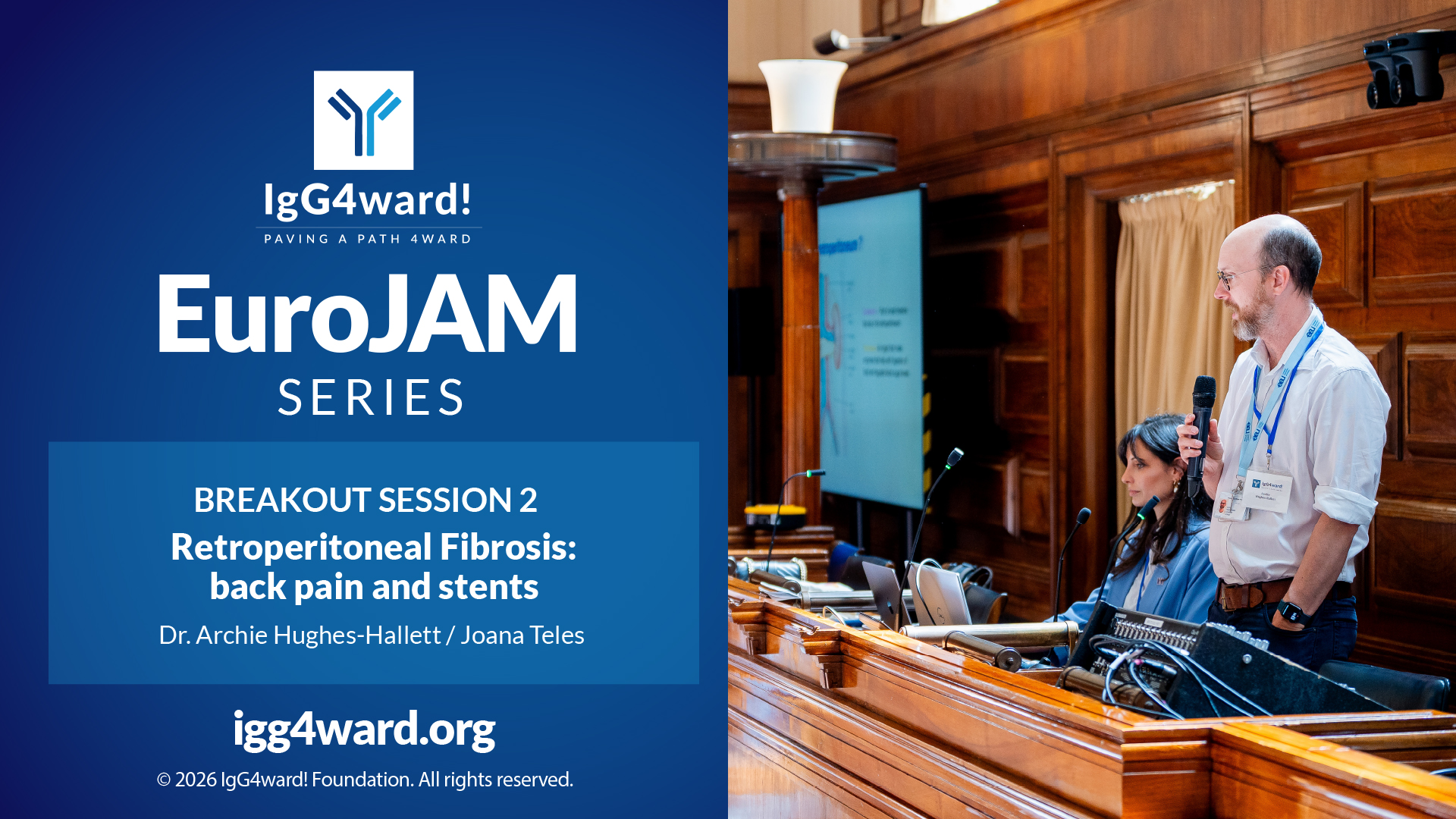
IgG4ward! EuroJAM Session 6: Retroperitoneal fibrosis, back pain, stents, and kidney health
Learn how retroperitoneal fibrosis can affect people living with IgG4-related disease. Dr. Archie Hughes-Hallett and Joanna Teles, a Kidney Nurse Specialist, explain back and abdominal pain, urinary obstruction, hydronephrosis, ureteric stents, nephrostomy tubes, surgical considerations, and kidney health.
Read more
IgG4ward! EuroJAM: Hope in action
Hope was a theme throughout the IgG4ward! EuroJAM - but not as wishful thinking. Patients, caregivers, researchers, physicians and industry partners came together to share knowledge, build connections and move the conversation around IgG4-related disease forward. Here's a look back at the event and what's coming next.
Read more