
IgG4ward! Good Question Series: How can I tell whether my symptoms are an IgG4-RD flare?
Can fatigue, joint pain, or simply not feeling well mean that IgG4-related disease is active again? In this Good Question, UK nephrologist Dr. James Tomlinson offers perspective for patients and caregivers navigating new, persistent, or changing symptoms.

Good question:
How can I tell whether my symptoms are an IgG4-RD flare?
Why this question matters:
When people living with IgG4-related disease (IgG4-RD) experience fatigue, joint pain, or simply do not feel well, they may understandably wonder whether their disease is active again.
Is this an IgG4-RD flare? Should I be concerned? How can I tell the difference?
These questions come up frequently within the IgG4-RD community. Symptoms are real and deserve attention, but understanding what they mean is not always simple.
During the Key Opinion Leader Panel at IgG4ward! EuroJAM, Katharine Provencher raised this concern on behalf of patients and caregivers.
Hear from the expert:
At the EuroJAM, UK nephrologist Dr. James Tomlinson responds to this important question and offers perspective for patients and caregivers navigating new, persistent, or changing symptoms.
Answer:
Not every symptom means that IgG4-RD is flaring.
As Dr. Tomlinson explains, one important consideration is the trajectory, or pattern, of symptoms over time:
Are they staying the same? Are they improving? Are they becoming progressively worse?
Because it can sometimes be difficult to interpret what the body is doing, tracking symptoms and meaningful changes may provide helpful information.
Depending on the individual and how IgG4-RD has affected them - particularly which organ or organs have been affected - self-monitoring might include changes in weight or blood pressure, visible swelling over an eye or salivary gland, abdominal pain, or another physical change. Photographs may also be helpful when a change is perceived depending on the nature of the symptom.
This information cannot confirm that a flare is occurring, but it may help patients communicate changes more clearly to their healthcare team.
Important point:
Fatigue, joint pain, and generally not feeling well are real and deserve attention. However, these symptoms cannot, by themselves, establish that IgG4-RD is active.
Objective medical evaluation is often needed to better understand what symptoms may mean. This could include a physical examination, laboratory testing, imaging, or comparisons with earlier findings.
Understanding that every symptom does not necessarily represent active IgG4-RD does not mean that symptoms should be ignored or dismissed. People living with IgG4-RD can also experience unrelated illness and health concerns that require appropriate evaluation and care.
A reassuring perspective:
Living with a rare disease can make every new symptom feel significant. It is natural to worry that fatigue, pain, or a difficult day means that IgG4-RD has become active again.
Sometimes, objective evaluation may provide reassurance that there is no evidence of major change. At other times, it may identify active disease that needs to be managed.
The goal is not to ignore what you are feeling or to assume that every symptom represents a flare. It is to recognize meaningful changes and work with your healthcare team to better understand what may be happening.
Final note:
Every person’s experience with IgG4-RD is different. There is no single symptom, laboratory result, or monitoring approach that can identify active disease in every person.
Learning what to monitor and how to communicate changes can support more informed conversations with your healthcare team.
When symptoms are new, worsening, persistent, or concerning, speak with your healthcare provider. Urgent or severe symptoms should be evaluated promptly.
Medical disclaimer:
The information provided in this Good Question, including the accompanying video, is for educational and informational purposes only and is not intended as a substitute for professional medical advice, diagnosis, or treatment. IgG4-related disease can affect each person differently. Always consult your healthcare provider with questions about your individual health, symptoms, treatment, or monitoring.
Looking for more Good Questions?
We have a dedicated section for the Good Question Series in our Resources library. If you’ve missed previous topics or want to revisit past discussions, you can find them all there - each one answered by leading experts in the field.
Thank you to our sponsor for supporting patient education through our Good Question Series:




A healthcare appointment guide for patients and providers
A guide to help you quickly share what IgG4-RD is, how it has affected your body, and what your healthcare team may need to know to provide effective care.
Read more
What to expect at IgG4ward! CamJAM: October 11 in Cambridge
Learn what to expect at IgG4ward! CamJAM on October 11, 2026, in Cambridge, Massachusetts: IgG4-RD education, expert Q&A, and connection for patients and caregivers.
Read more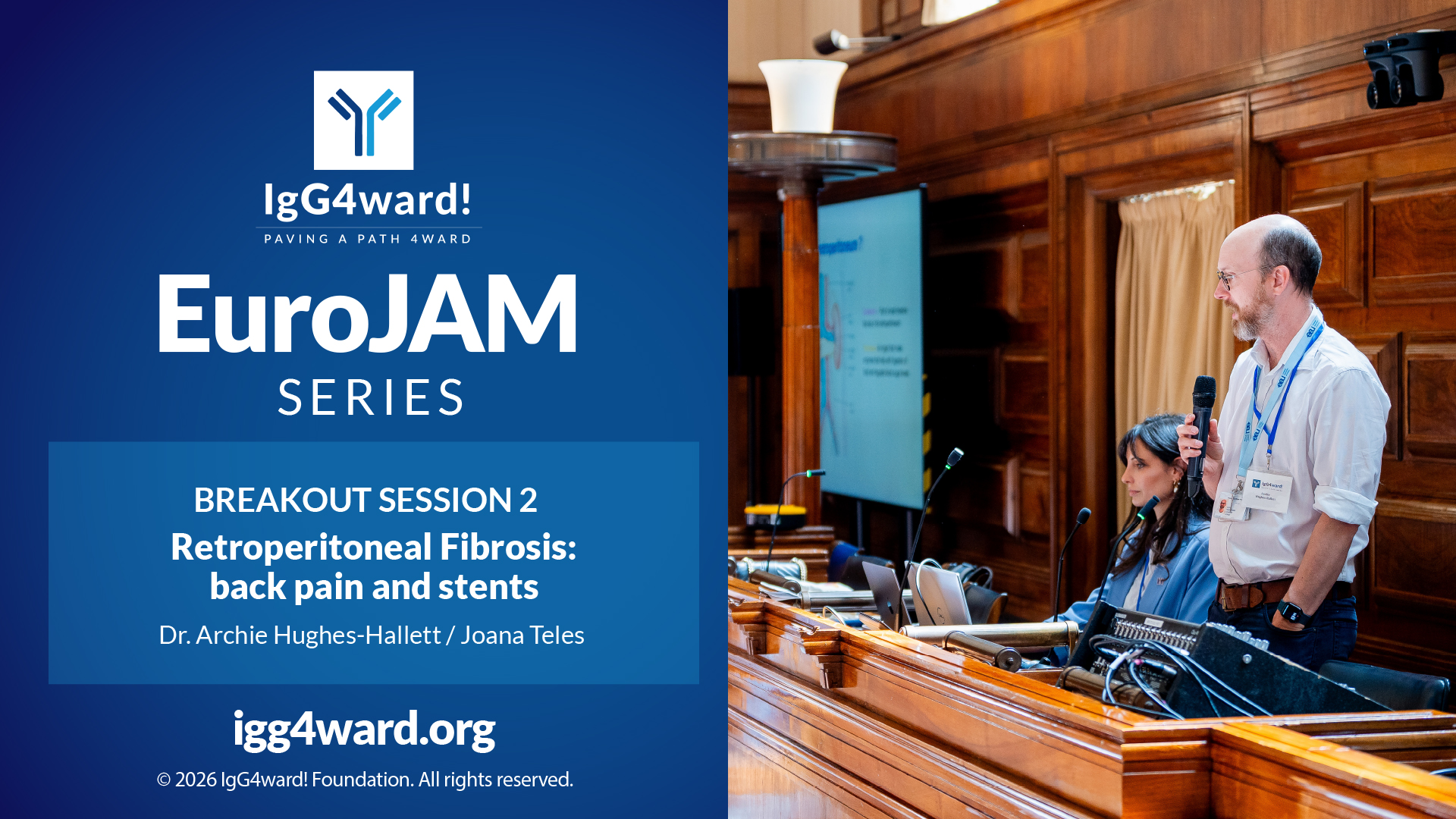
IgG4ward! EuroJAM Session 6: Retroperitoneal fibrosis, back pain, stents, and kidney health
Learn how retroperitoneal fibrosis can affect people living with IgG4-related disease. Dr. Archie Hughes-Hallett and Joanna Teles, a Kidney Nurse Specialist, explain back and abdominal pain, urinary obstruction, hydronephrosis, ureteric stents, nephrostomy tubes, surgical considerations, and kidney health.
Read more
IgG4ward! EuroJAM: Hope in action
Hope was a theme throughout the IgG4ward! EuroJAM - but not as wishful thinking. Patients, caregivers, researchers, physicians and industry partners came together to share knowledge, build connections and move the conversation around IgG4-related disease forward. Here's a look back at the event and what's coming next.
Read more