
IgG4ward! Good Question Series: What does it mean that IgG4-related disease (IgG4-RD) is a slow-moving disease?
IgG4-related disease (IgG4-RD) is generally a slow-moving disease. In this Good Question, rheumatologist Dr. John H. Stone explains what that can mean after diagnosis and offers perspective for patients and caregivers living with IgG4-RD.

Good question:
What does it mean that IgG4-related disease (IgG4-RD) is a slow-moving disease?
Answer:
Learning that you have IgG4-related disease can answer one big question, but it can also create many new ones.
What happens next? How quickly can things change? Should I be worried about what might happen between appointments?
For some people living with IgG4-RD and their caregivers, that uncertainty can feel like waiting for “the other shoe to drop”.
These are important questions, particularly because IgG4-RD is generally considered a slow-moving disease. Understanding what “slow-moving” means and what it does not mean can help put the course of the disease into perspective and support more informed conversations with your healthcare team.
At the IgG4ward! EuroJAM, Dr. John Stone, spoke about what “slow-moving” really means and addressed that feeling of waiting for “the other shoe to drop.”
The short answer:
IgG4-RD is usually an indolent, or slow-moving disease.
Before diagnosis, that can present a challenge. Because the disease may develop gradually, inflammation can go unrecognized for some time and may lead to organ damage.
After diagnosis, however, understanding the generally slow-moving nature of IgG4-RD can offer a different – and potentially reassuring – perspective.
But what does that mean for someone living with IgG4-RD?
Hear from the Expert:
Dr. John H. Stone shares an important perspective on the slow-moving nature of IgG4-RD and what it can mean for people living with the disease after diagnosis.
Important point:
Slow-moving does not mean that IgG4-RD should be ignored or untreated.
IgG4-RD can cause inflammation and organ damage, particularly when the disease goes unrecognized and untreated for a long period of time.
Describing IgG4-RD as “slow-moving” is a description of how the disease generally behaves, not a recommendation to delay or forgo treatment.
Treatment decisions are individualized. People living with IgG4-RD should work with their healthcare providers to determine the most appropriate treatment and follow-up for their individual disease.
Ongoing monitoring is also important. What that monitoring looks like can vary from person to person depending on their disease history and the organs involved.
A reassuring perspective:
Living with a rare disease can come with uncertainty, even after receiving a diagnosis.
As Dr. Stone explains, the slow-moving nature of IgG4-RD can work against patients before diagnosis because the disease can be insidious and my go unrecognized for a long time.
Once diagnosed, however, there is an important difference: the disease has been identified and can be appropriately treated and monitored.
The slow-moving nature of IgG4-RD does not mean that treatment can be delayed or that the disease can be simply watched without appropriate medical care. IgG4-RD can cause organ damage and may become active again after treatment. Therefore, appropriate treatment and ongoing monitoring remain important.
Understanding how the disease generally behaves, however, help put some of the uncertainty about what might happen next into perspective.
And perhaps, as Dr. Stone explains, help people living with IgG4-RD spend a little less time waiting for the “other shoe to drop”.
Final note:
Every person’s experience with IgG4-RD is different. Understanding that IgG4-RD is generally a slow-moving disease can provide helpful context, but individual experiences and care may vary.
Knowing more about how IgG4-RD generally behaves can help people living with the disease and their caregivers, feel better informed as they navigate life with the disease.
Medical disclaimer:
The information provided in this Good Question, including the accompanying video, is for educational and informational purposes only and is not intended as a substitute for professional medical advice, diagnosis, or treatment. IgG4-related disease can affect each person differently. Always consult your healthcare provider with questions about your individual health, symptoms, treatment, or monitoring.
Looking for more Good Questions?
We have a dedicated section for the Good Question Series in our Resources library. If you’ve missed previous topics or want to revisit past discussions, you can find them all there - each one answered by leading experts in the field.
Thank you to our sponsor for supporting patient education through our Good Question Series:



A healthcare appointment guide for patients and providers
A guide to help you quickly share what IgG4-RD is, how it has affected your body, and what your healthcare team may need to know to provide effective care.
Read more
What to expect at IgG4ward! CamJAM: October 11 in Cambridge
Learn what to expect at IgG4ward! CamJAM on October 11, 2026, in Cambridge, Massachusetts: IgG4-RD education, expert Q&A, and connection for patients and caregivers.
Read more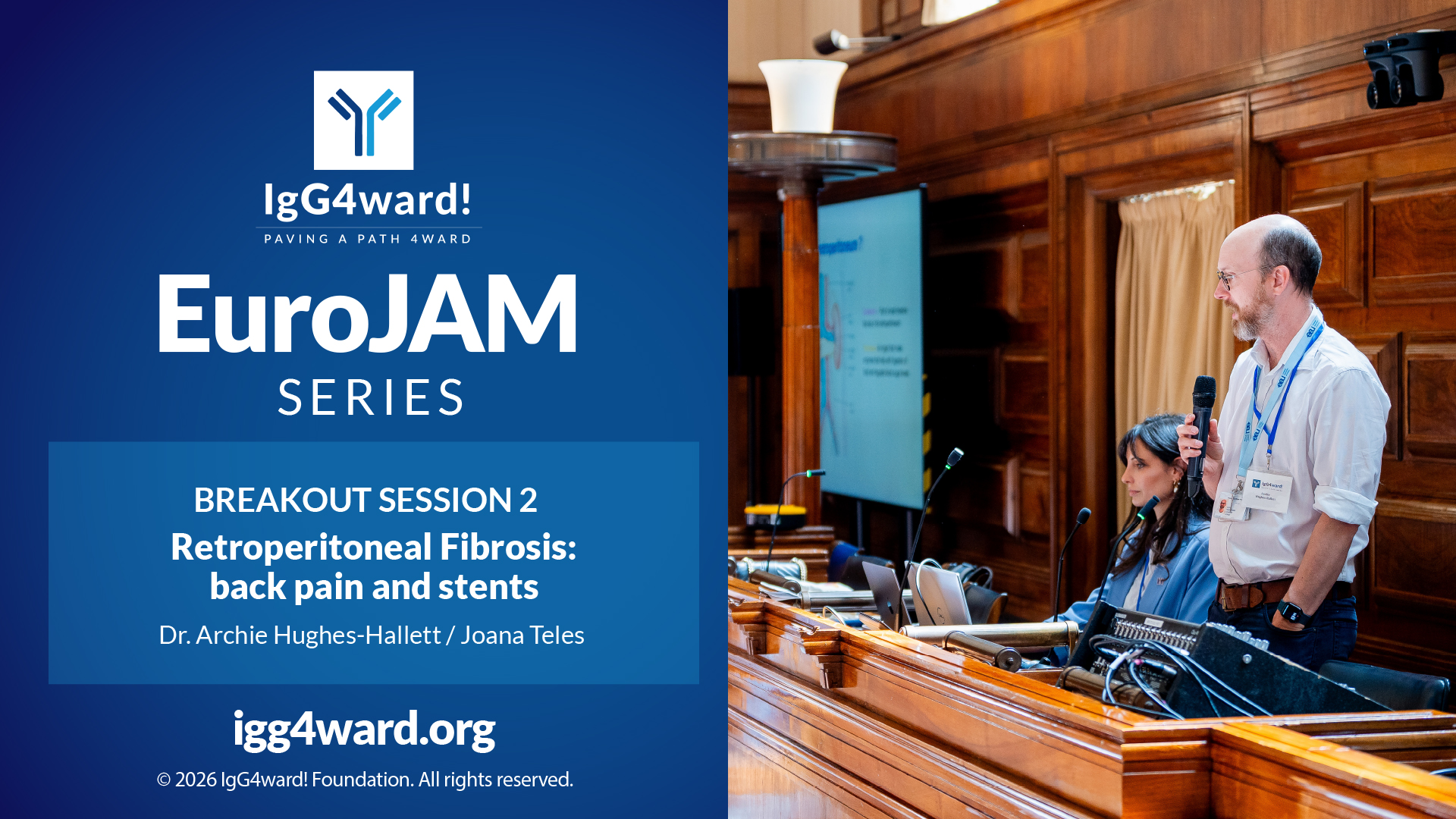
IgG4ward! EuroJAM Session 6: Retroperitoneal fibrosis, back pain, stents, and kidney health
Learn how retroperitoneal fibrosis can affect people living with IgG4-related disease. Dr. Archie Hughes-Hallett and Joanna Teles, a Kidney Nurse Specialist, explain back and abdominal pain, urinary obstruction, hydronephrosis, ureteric stents, nephrostomy tubes, surgical considerations, and kidney health.
Read more
IgG4ward! EuroJAM: Hope in action
Hope was a theme throughout the IgG4ward! EuroJAM - but not as wishful thinking. Patients, caregivers, researchers, physicians and industry partners came together to share knowledge, build connections and move the conversation around IgG4-related disease forward. Here's a look back at the event and what's coming next.
Read more