
Bookmark this lesson
Login or create an account to save and access your bookmarks
Bookmark this lesson
Login or create an account to save and access your bookmarks
Not yet registered?
What you can access by simply creating a account:
Register today to get the most out of the education academy. Save your progress, bookmarks lessons, track your progress plus more...

Save your progress in this lesson so you can pick it up where you left off.

Add lessons to your bookmarks so you can quickly return to them in the future.

Track your progress throughout the course to see what you have achieved.
Organ affected: kidneys
Kidney problems in IgG4-RD: what labs, urine, and scans show, and how care protects kidney function long-term.
 6 lessons
 Total: tbc
Organ Overview
Lesson 1 Organ Overview
Learn how kidneys filter blood, why urine tests matter, and how IgG4-RD can affect kidney tissue or urine flow.
How kidneys work and how IgG4-RD can affect them
IgG4-related disease, or IgG4-RD, can affect many parts of the body. In this lesson, we will focus on the kidneys. The kidneys are not large organs, but they do a remarkable amount of work. They sit in the back of the body, one on each side of the spine, and they quietly filter the blood twenty-four hours a day.
A helpful way to picture the kidneys is to imagine two careful sorting stations. Blood arrives carrying water, minerals, nutrients, and waste products. The kidneys help decide what should stay in the body and what should leave as urine. Most of this work happens entirely without you being aware of it, which is why kidney problems can sometimes grow quietly before symptoms appear.
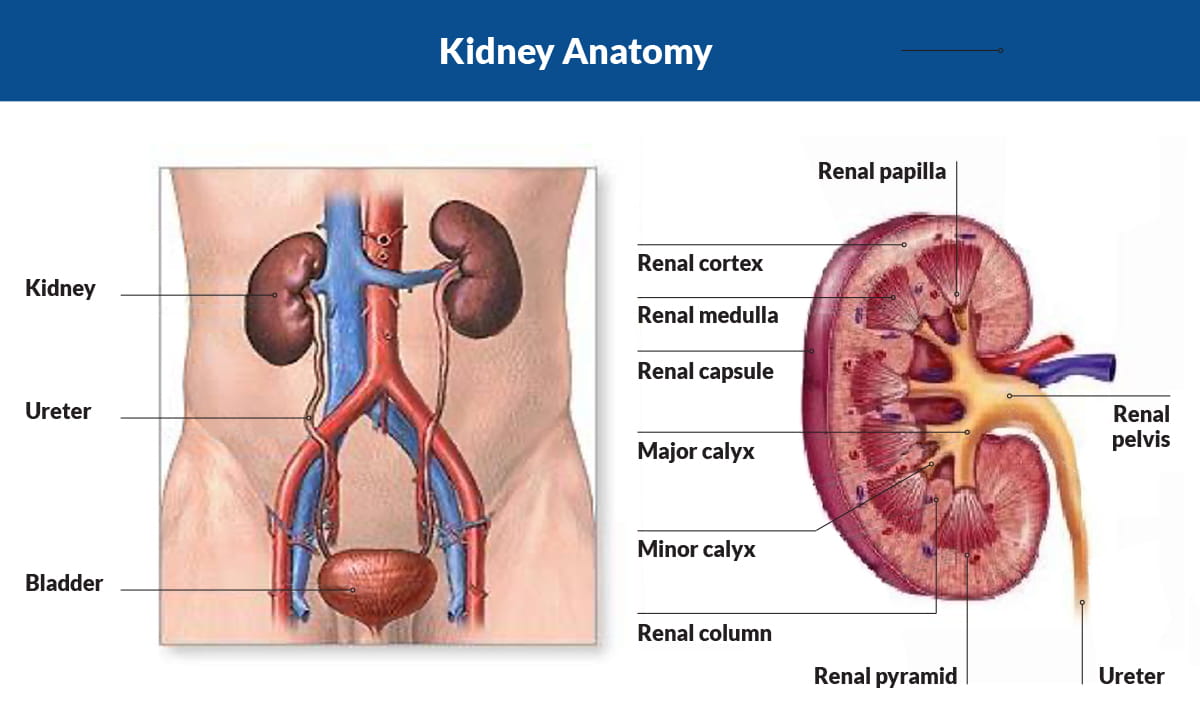
Body part | Function |
|---|---|
Kidney | Filters blood and removes waste. |
Renal artery | Brings blood into the kidney. |
Glomeruli | Tiny filters that clean the blood. Each kidney normally has 1 million glomeruli! |
Tubules/interstitium | Regions between the glomeruli. The “tubulo-interstitium” is the most common part of the kidneys affected by IgG4-RD. The tubules contained in this interstitial region contribute greatly to the kidneys’ role in maintaining balance of fluids, proteins, and electrolytes (e.g., sodium and potassium). |
Renal pelvis | Collects urine inside the kidney. |
Ureter | Carries urine from the renal pelvis to the bladder. |
Retroperitoneum | Active inflammation or scar tissue in the retroperitoneal space can block urine flow, typically by obstructing the ureters, leading to the condition of “hydronephrosis”. |
Where the kidneys are and how urine flows
The kidneys are two bean-shaped organs near the back of the abdomen. Blood flows into each kidney through a blood vessel called the renal artery. After the kidneys filter the blood, the cleaned blood leaves through the renal vein.
The fluid that the kidneys remove from the blood by filtering becomes urine. Urine then travels from each kidney to the bladder through a narrow tube called the ureter. Each kidney has one ureter. The bladder stores urine until it leaves the body through the urethra.
This pathway matters in IgG4-RD because processes that affect the kidney can happen in more than one place. Sometimes the kidney tissue itself is inflamed. Other times, the kidney may be harmed because urine cannot drain normally through the ureter.
The tiny filters inside each kidney
In this video from the first IgGward! Jamboree, Dr. Saif Alenizi, a nephrologist at Brigham and Women’s Hospital in Boston, explains how each tiny kidney filter receives its own blood supply.
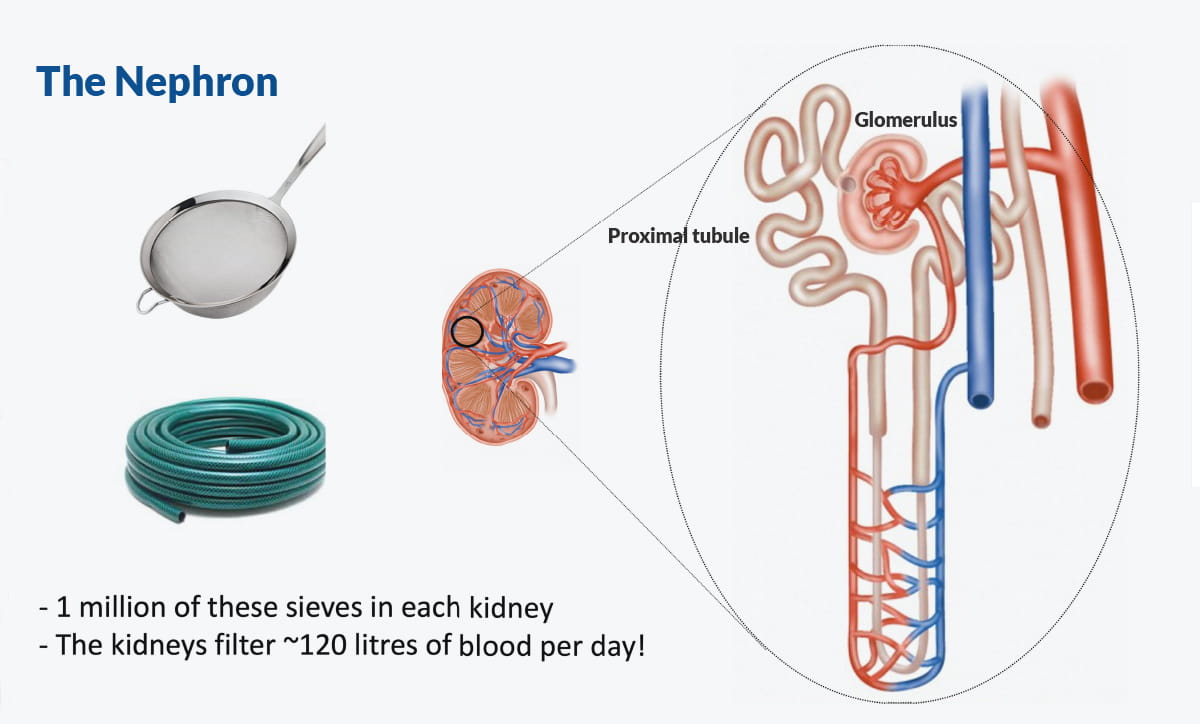
Inside each kidney are many small units called nephrons. Each nephron includes a tiny filter called a glomerulus. You can think of a glomerulus as a very fine strainer. It helps keep important things, like blood cells and most proteins, inside the bloodstream. At the same time, it allows extra fluid and waste to pass into the urine.
Dr. Alenizi explains that each kidney has about 1 million filtering units.1 That number helps show why kidneys have a lot of reserve. A person can lose some kidney function and still feel well for a time. But that reserve can also make kidney disease harder to notice early.
What healthy kidneys do
Healthy kidneys do far more than make urine. They help balance salt, water, and minerals so the body does not hold on to too much fluid. When the body holds too much fluid, a person may develop swelling, shortness of breath, or higher blood pressure.
Kidneys also remove waste products from the blood. A blood test known as a creatinine level provides a general indication of how well or how poorly the kidneys are working. A high creatinine level indicates that the performance of the kidneys is suboptimal, either as a result of an acute process (e.g., active IgG4-RD involving the kidneys), damage from a previously active disease that is now stable after treatment, or another process such as high blood pressure that has affected the kidneys adversely.
The kidneys also help control blood pressure, support red blood cell production through the secretion of a hormone called “erythropoietin," and help activate vitamin D. Vitamin D is important for bone health. Therefore, kidney disease can affect many parts of the body, not just urination.
“The kidney is not just a pump… it’s a very complex organ… it does a lot of things to keep your entire endocrine system functioning properly.”
Dr. Saif Alenizi, a nephrologist at Brigham and Women’s Hospital in Boston.
How clinicians test kidney function
Kidney testing usually starts with two simple tools: a blood test and a urine test.
Blood test
A blood test can measure creatinine, a waste product that kidneys usually remove. When kidney filtering slows, creatinine can build up in the blood. Clinicians use creatinine in a formula to estimate the eGFR, or estimated glomerular filtration rate. The eGFR is a number that helps quantify how well the kidneys are filtering. When the kidneys are not functioning optimally, the serum creatinine level becomes higher and the eGFR gets lower.Urine test
A urine test (urinalysis) can detect proteinuria, which means the finding of an excessive amount of protein in the urine. A urinalysis can also reveal hematuria, which means the detection of blood in the urine. Protein and blood are usually meant to stay inside the blood vessels. If they appear in the urine, it can be a clue that the kidney filters are irritated, inflamed, or leaking.
This is a key point in IgG4-RD care: blood tests alone may not tell the whole story. That’s why it’s important to check urine along with blood work because protein or blood in the urine can be an early marker of kidney disease.2
“Protein or blood in the urine can be an early marker of kidney disease, which is why urine testing matters alongside blood work.”
Dr. Jason Cobb, Nephrologist, Emory University
Acute kidney injury and chronic kidney disease
Two terms often come up in kidney care: acute kidney injury and chronic kidney disease.
Acute kidney injury
Acute kidney injury, often shortened to “AKI”, means that the kidney function has worsened over a short period of time. It is like a sudden interruption in the kidney’s usual work. In IgG4-RD, this can happen if inflammation affects the kidney tissue itself or if the urine flow from the kidney becomes blocked.
Chronic kidney disease
Chronic kidney disease, often shortened to “CKD”, means that reductions in kidney function have developed and lasted over time. CKD is usually described in stages, often using the eGFR to differentiate each stage.CKD stages move from stage 1 to stage 5, with stage 5 being the most severe.1
Defining these stages can help your care team describe what is happening and decide what to do next. The goal is to find kidney involvement early, treat inflammation when it is present, relieve blockage if it is happening, and protect kidney function for the long term.
How IgG4-RD can affect the kidney tissue
IgG4-related kidney disease can affect the kidney tissue itself. One important pattern is called tubulointerstitial nephritis. This long term means inflammation in the small tubes and spaces that are situated between the glomeruli. A simpler way to say it is: the working tissue of the kidney becomes inflamed.
Another pattern is membranous nephropathy, a kidney filter problem that often causes protein to leak into the urine. In this situation, a person may have a worrisome amount of proteinuria even if some other blood test numbers look less alarming at first.
IgG4-RD can also be linked with glomerulonephritis, which means inflammation of the glomeruli, the tiny filters inside the kidney. Dr. Cobb describes glomerulonephritis as a “big, long, fancy word” for inflammatory conditions within the filtering structure of the kidney.2 That plain explanation is helpful: it means that the filter area is inflamed.
How IgG4-RD can affect urine drainage
IgG4-RD can also affect the area around the kidneys. Retroperitoneal fibrosis means inflammation and scar-like tissue build up in the deep back part of the abdomen, called the retroperitoneum. The retroperitoneum is an anatomical area that includes the kidneys, the ureters, and major blood vessels.
If scar-like tissue surrounds or squeezes a ureter, urine may not drain well from the kidney to the bladder. This is called obstruction, which means blockage. Obstructed urine flow because of a blockage of the ureter leads to a condition known as “hydronephrosis.” Hydronephrosis can lead to acute kidney injury, chronic kidney disease, or both.
This is why imaging can be important. Blood and urine tests show how the kidney is functioning, while imaging can help show whether the kidney or ureter looks swollen, blocked, or surrounded by abnormal tissue. The kinds of imaging studies that detect hydronephrosis are include a renal ultrasound (sometimes called sonogram) or a CT scan of the abdomen and pelvis.
Why symptoms may not tell the whole story
Kidney disease does not always announce itself clearly. Some people feel tired, nauseated, swollen, short of breath, or mentally foggy. Some have high blood pressure. Others notice flank pain or trouble urinating. But many people have no clear symptoms at first.
That can be frustrating, but it is also why regular monitoring is so valuable. Blood tests, urine tests, imaging, and sometimes biopsy give the care team a way to see what the body may not be saying out loud.
A biopsy is a small tissue sample taken to look for signs of disease under a microscope. Not everyone needs a kidney biopsy, but when the diagnosis is unclear, a biopsy can help show what type of kidney involvement is present and how much inflammation or scarring is there.
Inflammation and scar tissue
Kidney involvement in IgG4-RD can happen in two broad ways.
First, IgG4-RD can inflame the kidney tissue itself.
Second, IgG4-RD can cause scar-like tissue around the ureters, blocking urine flow and harming the kidney from the outside.
Both patterns matter. Both can be serious. And both are easier to manage when they are recognized early.
The reassuring part is that kidney care has clear tools.
Creatinine and eGFR help show how well the kidneys are filtering.
Urine tests help show whether protein or blood is leaking. Imaging can show swelling or blockage.
Biopsy can help clarify the diagnosis when needed.
Summary
The kidneys are quiet, hardworking organs. They filter blood, remove waste, balance fluid and minerals, help control blood pressure, support red blood cell production, and help activate vitamin D.
In IgG4-RD, kidney involvement can affect the kidney tissue itself or the drainage pathway around the kidney. Because symptoms may be mild or absent early on, blood tests and urine tests are important. Imaging and biopsy may also be used when the care team needs more information. The goal is not just to name the problem.
The goal is to protect kidney function, treat inflammation when it is active, relieve blockage when it is present, and give you a clearer understanding of what your care team is watching.
References
Alenizi S. IgG4ward_JAMBOREE_Film #8: Kidney breakout session.
Cobb J. IgG4_PeachJAM_Film_8_Dr Cobb_IgG4_Related Kidney Disease.
 Save this lesson so you can resume it later
 Copy Link
 Share On X
 Share On Facebook
 Share On LinkedIn
 Share in Whatsapp
Further reading
IgG4ward reading guide explaining retroperitoneal fibrosis and how it can affect urine flow and kidneys. NIDDK patient resource explaining kidney blood and urine tests, including GFR and urine albumin. National Kidney Foundation guide to urine albumin testing and why protein in urine matters.Patient guides for doctor appointments
Educating new doctors and healthcare professionals on your IgG4-RD journey can feel like a full-time job. Download, print, or have your doctor scan the QR code of our patient guides to make every appointment more productive.
View guides