
Bookmark this lesson
Login or create an account to save and access your bookmarks
Bookmark this lesson
Login or create an account to save and access your bookmarks
Not yet registered?
What you can access by simply creating a account:
Register today to get the most out of the education academy. Save your progress, bookmarks lessons, track your progress plus more...

Save your progress in this lesson so you can pick it up where you left off.

Add lessons to your bookmarks so you can quickly return to them in the future.

Track your progress throughout the course to see what you have achieved.
Organ affected: salivary & lacrimal glands
How IgG4-RD swells tear/ saliva glands, how it differs from Sjögren’s or infection, and what helps most.
 6 lessons
 Total: tbc
 6 minutes
Common questions
Answers to FAQs about symptoms such as dry eyes or mouth, swelling of lacrimal and salivary glands in IgG4-RD.
Common questions about salivary & lacrimal gland IgG4-RD
If IgG4-related disease (IgG4-RD) affects your salivary glands (like the parotid or submandibular glands) or lacrimal glands (tear glands), it can feel unsettling, especially because the swelling can look like other illnesses.
Many people ask the same practical questions: Is this Sjögren’s? Is it cancer? Will the swelling go away? What can I do about dryness? Here are the most common concerns we hear, answered with practical care.
This lesson covers some of the most commonly asked questions about IgG4-RD and its effects on the salivary and lacrimal glands.
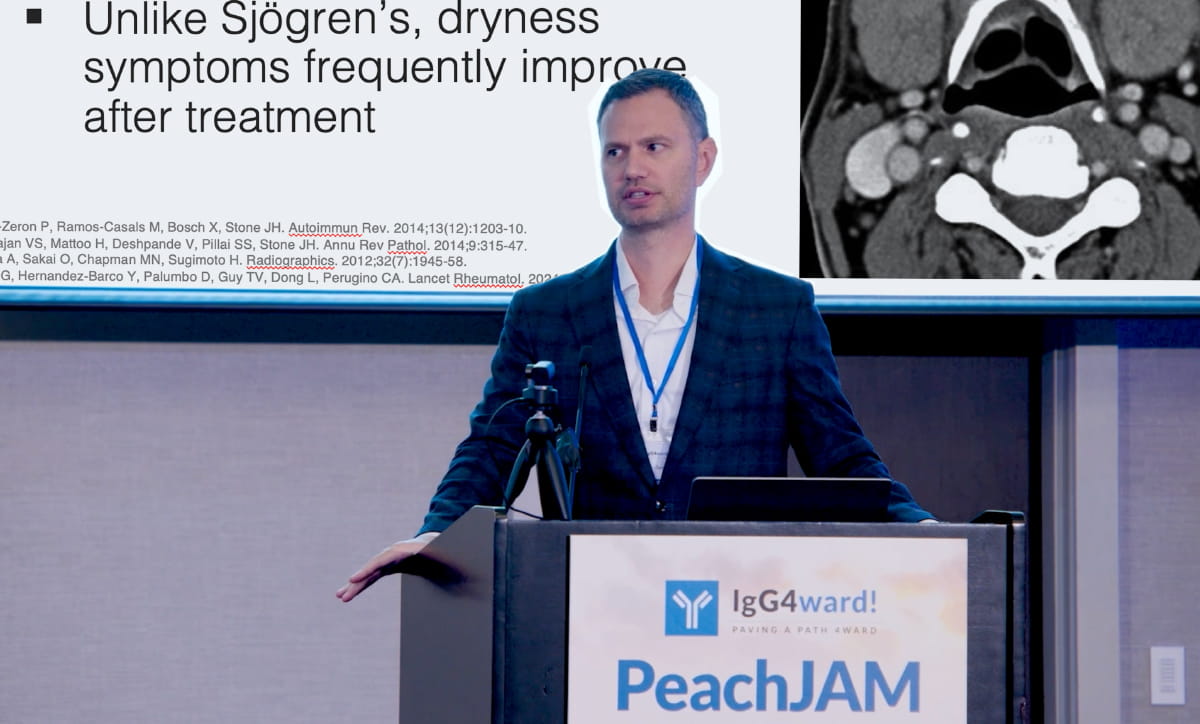
Frequently asked questions (FAQs)
1. Is this the same as Sjögren’s syndrome?
Although IgG4-RD and Sjögren’s syndrome were confused for many decades, they are, in fact, two very different diseases. IgG4-RD can cause painless swelling of the lacrimal and major salivary glands (sometimes called Mikulicz disease) and may also cause dry eyes and dry mouth.
Sjögren’s is a different immune disease with different typical blood markers and patterns of inflammation. Dr. John Stone, rheumatologist with Mass General Hospital and founder of the IgG4ward! Foundation, often highlights how IgG4-RD can mimic Sjögren’s closely enough that people are referred specifically to “rule out Sjögren’s,” and careful testing is needed to separate the two. If you were told “maybe Sjögren’s,” that’s a common step on the path to the right diagnosis, not a sign anyone did something wrong.
There are a few clinical “pearls” of knowledge that help differentiate these two conditions:
If the submandibular glands are involved in isolation (i.e., without obvious parotid or lacrimal gland enlargement), then the correct diagnosis is probably IgG4-RD. Sjögren’s syndrome does not cause isolated submandibular gland enlargement.
If all three of these organs are affected at the same time, then the diagnosis is almost certainly IgG4-RD. Sjögren’s frequently involves the lacrimal and parotid gland together, but prominent submandibular gland enlargement is unusual in Sjögren’s.
Parotid gland enlargement out of proportion to the other glands favors Sjögren’s.
If only the lacrimal glands are affected, a biopsy may be needed to differentiate the two conditions for certain. However, blood tests can also help: Sjögren’s is not likely to be associated with dramatic serum IgG4 concentrations, and IgG4-RD is not associated with anti-Ro antibodies (but Sjögren’s is).
2. Does gland swelling mean cancer?
Most of the time, no, but it does deserve a careful evaluation. IgG4-RD often forms “tumor-like” swelling (doctors may call these mass-like or tumefactive lesions), which is one reason it can be mistaken for cancer.
In this regard, it’s important that clinicians don’t leap to one conclusion. Dr. Stone often says to cast a wider net and check for mimics.
The most reassuring path is usually a stepwise workup: physical examination, imaging, blood tests, and sometimes biopsy to confirm IgG4-RD and exclude look-alikes. If you’re feeling anxious, that reaction makes sense. A clear diagnosis plan often helps the worry settle.
3. Will my salivary or tear gland swelling go away?
In many people, swelling improves when the immune inflammation is quieted—often with medicines like glucocorticoids (steroids) and/or B-cell–targeting treatments (such as rituximab, in appropriate patients).
One helpful real-world example comes from an interview with patient William Joy: after B-cell depletion therapy, he described dramatic improvement in facial swelling and a return to normal life.
That said, IgG4-RD can be a chronic, relapsing condition, so some people need ongoing monitoring and sometimes repeat treatment if swelling returns. The goal is not just cosmetic improvement—it’s protecting gland function and preventing scarring over time.
4. My eyes feel dry or irritated, what can I do day to day?
Dry eye care usually starts simple: artificial tears, protecting your eyes from wind/fans, and using warm compresses if your eye doctor thinks oil glands are part of the problem.
Some people do fine with drops a few times a day; others need gels/ointments at night or prescription treatments, especially if symptoms are persistent. If you use eyedrops, it is important to make sure that the ones you use are preservative-free. The preservatives added to some eyedrop preparations have a drying effect on the ocular surface – exactly the opposite of what we are trying to achieve with them.
Here’s a good rule: if you have eye pain, light sensitivity, vision changes, or redness that’s getting worse, don’t “tough it out.” Call your clinician or eye doctor promptly. IgG4-RD can also affect tissues around the eyes, so new or one-sided swelling should be checked. 6
5. My mouth feels dry: how do I protect my teeth and feel more comfortable?
Dry mouth (xerostomia) is more than an annoyance—it can raise the risk of dental cavities. This is because having a sufficient amount of saliva is important for protecting teeth and maintaining oral health. Practical steps include frequent sips of water, sugar-free gum or lozenges to stimulate saliva (if you still make some), and saliva substitutes if needed. 10,11
The American Dental Association notes that sugar-free gum can increase saliva flow and help reduce tooth decay risk. In some cases, prescription saliva-stimulating medicines (like pilocarpine or cevimeline) may help and are worth discussing with your clinician. A dentist who understands dry mouth can be a strong ally in prevention.
6. How will I know if I’m flaring, and what should I watch for?
A flare is a return of symptoms or inflammation after a period of control, often more swelling, new tenderness/ pressure, or worsening dryness. Some patients also find that blood tests can help track disease activity, and treatment can sometimes be timed before major symptoms return.
That said, no single lab test tells the full story for everyone, and IgG4-RD can be quiet while still causing slow damage in some organs. 6
For lacrimal glands and eyes specifically, watch for: new or rapidly increasing swelling, vision changes, significant eye pain, fevers you can’t explain, or new symptoms in other body areas. Those are reasons to contact your care team.
7. Did I do something to cause this, and can lifestyle changes help?
You did not “cause” IgG4-RD. It is an immune-mediated disease, and the exact cause is still not fully known. It is likely that a variety of risk factors exist for IgG4-RD (genetic, environmental, infectious, other), but as is true with many immune-mediated conditions, the ultimate cause(s) remains uncertain.
What is always helpful: keep follow-up appointments, report new symptoms early, and focus on daily comfort measures (eye and mouth care) while your medical team treats the underlying inflammation.
8. How do doctors confirm IgG4-RD in the salivary or tear gland: what tests should I expect?
Most doctors take a step-by-step approach. First is a careful examination and history: when the swelling started, whether it comes and goes, and whether other organs could be involved. Blood tests may include serum IgG4, but this test alone can’t prove (or rule out) IgG4-RD, so it’s treated as one clue, not the whole answer.
Imaging (like ultrasound, CT, or MRI) can help show the pattern of gland involvement and guide next steps. When the diagnosis is still uncertain, or when doctors need to rule out look-alikes like Sjögren’s or lymphoma, a tissue biopsy may be recommended to confirm the diagnosis under the microscope.
Summary
When IgG4-RD affects the salivary or tear glands, people may have a lot of questions, especially about what it is (and isn’t), what to watch for, and what to do day to day. IgG4-RD swelling can mimic Sjögren’s sarcoidosis, ANCA- associated vasculitis, infections, or even cancer, as well as other conditions, so a careful diagnosis matters.
The good news is that many people improve with treatment and thoughtful monitoring.6 Meanwhile, simple routines for dry eyes and dry mouth can protect comfort and long-term health while your care team works on calming the immune system that’s driving the problem.
References
1. NIH Genetic and Rare Diseases Information Center (GARD). IgG4-related dacryoadenitis and sialadenitis. (Accessed 2026-02-22). URL: https://rarediseases.info.nih.gov/diseases/7043/igg4-related-dacryoadenitis-and-sialadenitis
2. Stone JH, Zen Y, Deshpande V. IgG4-Related Disease. N Engl J Med. 2012;366:539–551. DOI: 10.1056/NEJMra1104650. URL: https://www.nejm.org/doi/full/10.1056/NEJMra1104650
3. Abo-Helo N, Toubi E. IgG4-related disease: case report and literature review. Autoimmun Highlights. 2015;6:7–15. DOI: 10.1007/s13317-015-0069-3. URL (PMC full text): https://pmc.ncbi.nlm.nih.gov/articles/PMC4536235/
4. Peyronel F, Della-Torre E, Maritati F, et al. IgG4-related disease and other fibro-inflammatory conditions. Nat Rev Rheumatol. 2025;21:275–290. URL: https://www.nature.com/articles/s41584-025-01240-x
5. Stone JH; Provencher K. Video: Dr. Stone & Kat Discussion (IgG4-RD mimics Sjögren’s; broaden diagnostic net).
6. Lang D, Zwerina J, Pieringer H. IgG4-related disease: current challenges and future prospects. Ther Clin Risk Manag. 2016;12:189–199. DOI: 10.2147/TCRM.S99985. URL (PMC full text): https://pmc.ncbi.nlm.nih.gov/articles/PMC4760655/
7. Stone JH; Joy, William. Video: William Joy (lacrimal/parotid involvement; treatment response; monitoring/relapse).
8. Mayo Clinic Staff. Dry eyes: Diagnosis & treatment. Mayo Clinic. URL: https://www.mayoclinic.org/diseases-conditions/dry-eyes/diagnosis-treatment/drc-20371869
9. American Academy of Ophthalmology. Remedies to Reduce Dry Eye Symptoms; What Is Dry Eye? (patient guidance and red flags). URLs: https://www.aao.org/eye-health/tips-prevention/dry-eye-tips; https://www.aao.org/eye-health/diseases/what-is-dry-eye
10. American Dental Association. Xerostomia (Dry Mouth). (management options; prescription sialagogues and side effects). URL: https://www.ada.org/resources/ada-library/oral-health-topics/xerostomia
11. American Dental Association. Chewing Gum. (sugar-free gum increases saliva flow; tooth decay risk reduction). URL: https://www.ada.org/resources/ada-library/oral-health-topics/chewing-gum
12. Akiyama M, Alshehri W, Ishigaki S, Saito K, Kaneko Y. The immunological pathogenesis of IgG4-related disease categorized by clinical characteristics. Immunological Medicine. 2025;48(1):11–23.
 Save this lesson so you can resume it later
 Copy Link
 Share On X
 Share On Facebook
 Share On LinkedIn
 Share in Whatsapp
Further reading
Plain-language overview of gland involvement (NIH GARD). Practical dry eye self-care tips (American Academy of Ophthalwww.ada.org/resources/ada-library/oral-health-topics/xerostomia — Dry mouth care and dental protection strategies American Dental Association guidance on dry mouth, oral comfort steps, and protecting teeth.Patient guides for doctor appointments
Educating new doctors and healthcare professionals on your IgG4-RD journey can feel like a full-time job. Download, print, or have your doctor scan the QR code of our patient guides to make every appointment more productive.
View guides