
Bookmark this lesson
Login or create an account to save and access your bookmarks
Bookmark this lesson
Login or create an account to save and access your bookmarks
Not yet registered?
What you can access by simply creating a account:
Register today to get the most out of the education academy. Save your progress, bookmarks lessons, track your progress plus more...

Save your progress in this lesson so you can pick it up where you left off.

Add lessons to your bookmarks so you can quickly return to them in the future.

Track your progress throughout the course to see what you have achieved.
Treatment and disease management
Understand how inflammation is managed through steroids, immune therapies, and supportive care—and what to expect at each step.
 8 lessons
 Total: tbc
 7 minutes + video
Steroids
Steroids often work quickly, but doctors must taper them and add other medicines to prevent flares and reduce harm.
Steroids: Fast relief, careful taper
People with active IgG4-RD often improve quickly on steroids. But steroids aren’t ideal for long-term management, so doctors generally try to taper patients off of these medications as soon as it’s safe to do so. They may add other medications to prevent flares and reduce the side effects of steroids.
When IgG4-related disease (IgG4-RD) flares, steroids (glucocorticoids) are often the quickest way to calm inflammation and protect organs. Many people feel better within days.
But steroids are associated with side effects, many of them potentially serious. So the goal is using the right dose, to taper carefully, and to discontinue them entirely (if possible) as soon as it’s safe. Doctors look to create a “steroid-sparing” plan for future management.
Why treatment starts with steroids
A patient’s moment
William remembers the first time his left eye ballooned “like a softball.” In the hospital, IV prednisone shrank the swelling within days, fast enough to let him get back to work, but the trade-offs were real: irritability, sleepless nights, and a 100-pound weight gain over several years during repeated courses of steroids.
Putting out the fire
Glucocorticoids are the quickest tool to cool active inflammation in IgG4-RD and protect organ function.
Pancreas/bile ducts — When inflammation in the pancreas and bile ducts settles down, bile can flow again. The yellowing of the eyes and skin fades, itching eases, and appetite often returns.
Head/neck — In the head and neck, swollen lacrimal and major salivary glands gradually soften; the puffiness in front of the ears or under the jaw recedes, relieving the sense of pressure around the eyes and face.
Kidneys — In the kidneys, the tubules inflamed by IgG4-related tubulointerstitial nephritis can recover, which means that serum creatinine levels get lower and abnormalities on urine tests improve or resolve.
Lungs — In the lungs, shrinking inflammatory lesions can ease cough and shortness of breath so walking across a room, or up a flight of stairs, feels doable again.
Heart/arteries — When inflammation settles down around large arteries like the aorta, the tissue there becomes less thick and tight. That relief can ease pain and lowers the chance that the swollen tissue will press on nearby structures.
Most patients improve within days to weeks after starting therapy, with symptoms easing first and scans/labs following over weeks to months. Steroids work so well in IgG4-RD, in fact, that lack of a good response to an initial course of steroids is a good reason to question the diagnosis of IgG4-RD.
How effective is steroid treatment?
Steroids help most people with IgG4-RD. Across many studies, more than 8 out of 10 patients improve after starting prednisone. Nearly all patients with active inflammation respond. Responses may be less apparent in organs that have been damaged by IgG4-RD inflammation.
When steroids don’t work, it’s often because the disease in that area is dominated by scar-like tissue (fibrosis) rather than active inflammation. And scar tissue tends to shrink more slowly or not at all with medications. In those cases, doctors may pivot to other treatments to control inflammation and protect organ function.
Starting dose, induction, taper, and maintenance
Induction
Most people begin with a short course of daily prednisone (or prednisolone) to quickly reduce inflammation. This first phase is called induction—it’s meant to calm active disease fast and protect organs. A common starting range is 0.4–0.6 mg per kilogram of body weight per day for about 2–4 weeks.
Even the most active inflammation associated with IgG4-RD responds well to 40 mg/day of prednisone. Lower starting doses may be appropriate for more minor disease manifestations.
Taper
Once symptoms and inflammation markers are improving, the next phase is the taper. During a taper, your clinician lowers the dose step-by-step—often over 3–6 months—to reduce side effects while watching closely for return of symptoms.
Prednisone tapers need to be designed individually for each patient, based on the intensity of IgG4-RD inflammation, risk factors for doing poorly with steroid-induced side effects, and other considerations.
Maintenance
For some people, especially when IgG4-RD is more likely to flare, the plan may include maintenance therapy after tapering. Maintenance can mean staying on a very low steroid dose for a period of time, or using a steroid-sparing medicine so the disease stays quiet without ongoing higher-dose steroids.
The exact plan depends on which organs are involved, how active the disease is, and what side effects you experience—so it’s individualized for each person.
When organ problems need extra help
If retroperitoneal fibrosis squeezes the ureters and blocks urine flow, physicians often treat more aggressively at first. For at least a few days, a patient with such a disease complication might be started on prednisone in doses as high as 1 mg/kg/day (for example, 60 mg/day). For most patients, however, 40 mg/day is a reasonable starting dose.
In many cases, a ureteral stent is placed first to relieve the blockage right away; steroids then help the inflamed tissue shrink so the stent can eventually be removed.
How long will steroids be necessary?
Induction (getting control): Usually a few weeks at the initial dose.
Taper (stepping down): Gradually reduce over months; some centers taper to a low daily dose for a period to prevent flare, then aim to stop if stable.
Relapses can occur, which is why follow-up matters.
Key idea
Fast relief is common, but steroid plans must be individualized based on which organs are involved, how severe the disease is, and other health conditions. Working towards careful taper is the goal.
What steroid improvement looks like
Most people feel the change in their bodies first. Within days to a few weeks, pain often softens, swelling goes down, and the yellow of jaundice (if the bile ducts are affected) begins to fade as inflammation cools.
Over the following weeks to months, objective signs of improvement appear: scans show that previously inflamed areas are shrinking or less active, and routine blood work trends in a better direction.
One lab test deserves a special note: the serum IgG4 level. These numbers fall with successful treatment – particularly if they are high at the start of treatment. The serum IgG4 level can be a very helpful measure for gauging treatment response.
Some people have normal IgG4 levels even when IgG4-RD is clearly present. In addition, it is also important to remember that an elevated IgG4 is not specific to IgG4-RD and can be found in other conditions. That’s why each patient’s care team will always look at the whole picture— symptoms, imaging, and labs together—rather than relying on a single number.
Side effects: What to watch for
Steroids can cause increased appetite/weight gain, trouble sleeping, mood changes, higher blood sugar, higher blood pressure, swelling.
Longer-term risk: Bone loss (osteoporosis), eye pressure/cataracts, infections.
William’s story highlights how impactful this can be during repeated courses.
Doctors try to minimize risk by using the lowest effective dose for the shortest time, protecting bone health with calcium, vitamin D, weight-bearing exercise and medications), screening blood sugars, and transitioning to steroid-sparing strategies when appropriate.
Why “get off ASAP”? Steroids work, but the total (cumulative) dose drives side effects. Teams should plan a steroid-sparing strategy early—adding another medicine or using B-cell therapy—to let you taper sooner. An outline of a plan for getting a patient off steroids should be in place the day that steroids are started.
The great taper: Why we aim to minimize steroids
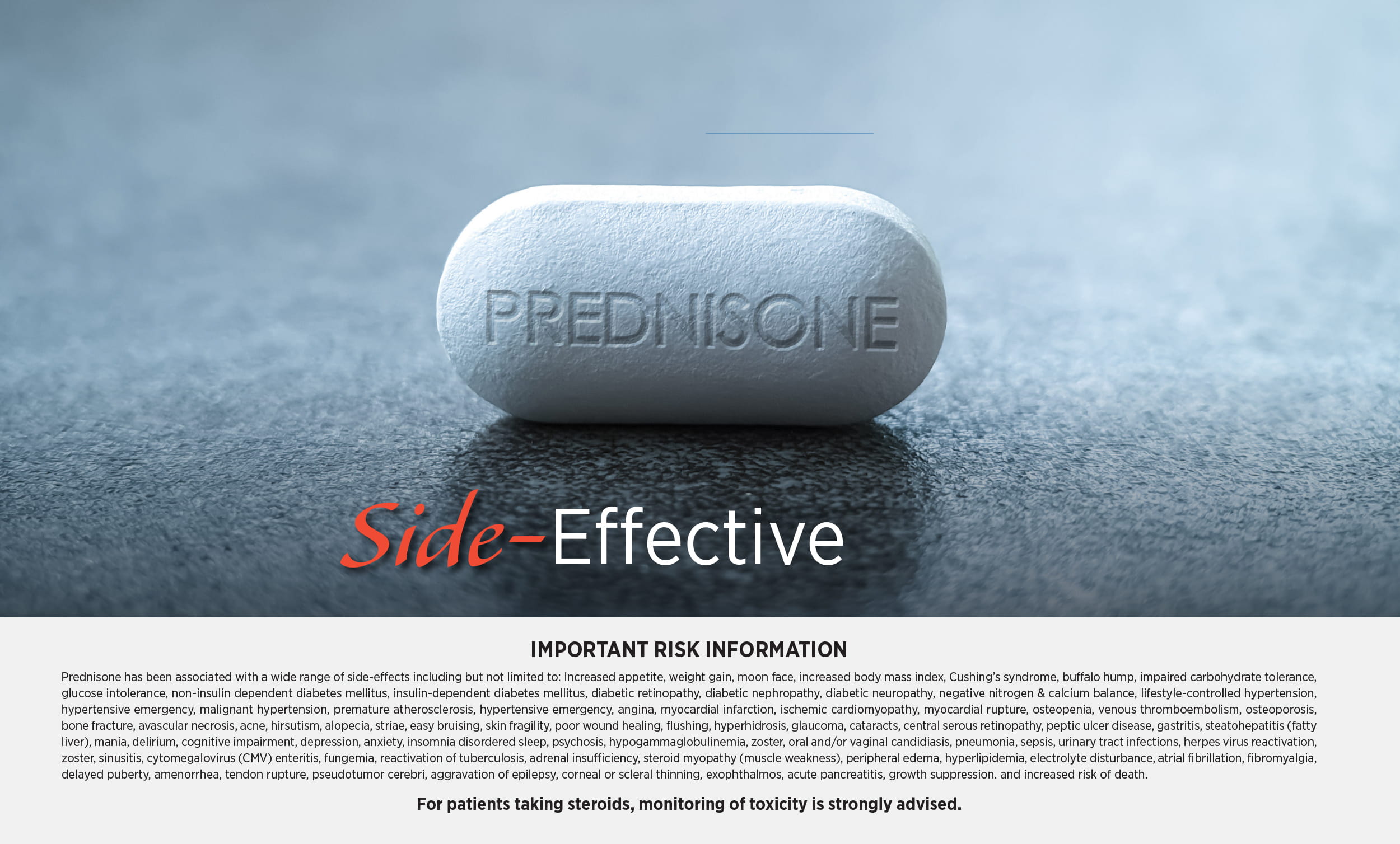
Glucocorticoids have changed lives since the first cortisone trials in the late 1940s, but they are a double‑edged sword. They suppress inflammation quickly and help confirm the diagnosis, yet long‑term use is linked to more than 80 recorded toxicities, from weight gain, mood changes, and insomnia to infection risk, high blood pressure, diabetes, bone loss, and fractures.
In children, steroids can also affect growth and psychosocial development. In the treatment of IgG4-RD, the goal is simple: use the lowest effective dose for the shortest time.
Physicians who treat people with IgG4-RD may talk about a process called the “great taper.” This is an ongoing commitment to reducing steroid exposure by planning early for steroid‑sparing therapy, monitoring side effects, and partnering with you on bone health, blood‑pressure management, and glucose tolerance. When possible, physicians move promptly to treatments like B‑cell depletion to control disease while tapering off and stopping steroids.
How steroids fit with other treatments
Steroids are the first-line treatment for active IgG4-RD because they work quickly. But the long-term goal is to taper off and move to a maintenance plan that keeps the disease quiet with fewer side effects. Once the flare is under control, your team will discuss longer-term options:
Rituximab (B-cell depletion): Helpful when disease is severe, involves multiple organs, keeps relapsing, or when steroids are risky or hard to taper. It may be used with, or instead of, steroids depending on the patient’s situation.
Traditional DMARDs (azathioprine, methotrexate, mycophenolate, and in select cases cyclophosphamide): Considered to lower relapse risk and reduce steroid exposure, though the strength of evidence about their effectiveness in IgG4-RD is generally low.
Response clues: If improvement with steroids is weak, clinicians re-check the diagnosis and look for advanced fibrosis (scar-like tissue), which can limit steroid benefit and prompt a different strategy.
Practical tips for patients
Before starting: Discuss vaccines (ideally update before heavy immunosuppression), bone health, blood sugar, sleep plan, and mental health supports.
While on steroids: Take exactly as prescribed, don’t stop abruptly, track side effects, and keep all follow-up visits.
Call your team quickly for fever, vision changes, severe mood changes, very high blood sugars, or yellowing of eyes/skin.
Summary
Steroids are the usual first step for active IgG4-RD because they work quickly.
Tapering and minimizing total dose lowers side-effect risk.
Relapses happen, so plans often include steroid-sparing medicines or B-cell therapy when needed.
Personalized support on your steroid journey
Get support and education on your steroid journey with a new digital companion, Sam (Steroids and Me). Find answers and learn how to work with your doctors for the best care and taper plan.
GET SAM NOWReferences
1. Stone JH, Zen Y, Deshpande V. IgG4-Related Disease. N Engl J Med. 2012;366:539-551.
2. Peyronel F, Della-Torre E, Maritati F, et al. IgG4-related disease and other fibro-inflammatory conditions. Nat Rev Rheumatol. 2025;21:275-290.
3. Lang D, Zwerina J, Pieringer H. IgG4-related disease: current challenges and future prospects. Ther Clin Risk Manag. 2016;12:189-199.
 Save this lesson so you can resume it later
 Copy Link
 Share On X
 Share On Facebook
 Share On LinkedIn
 Share in Whatsapp